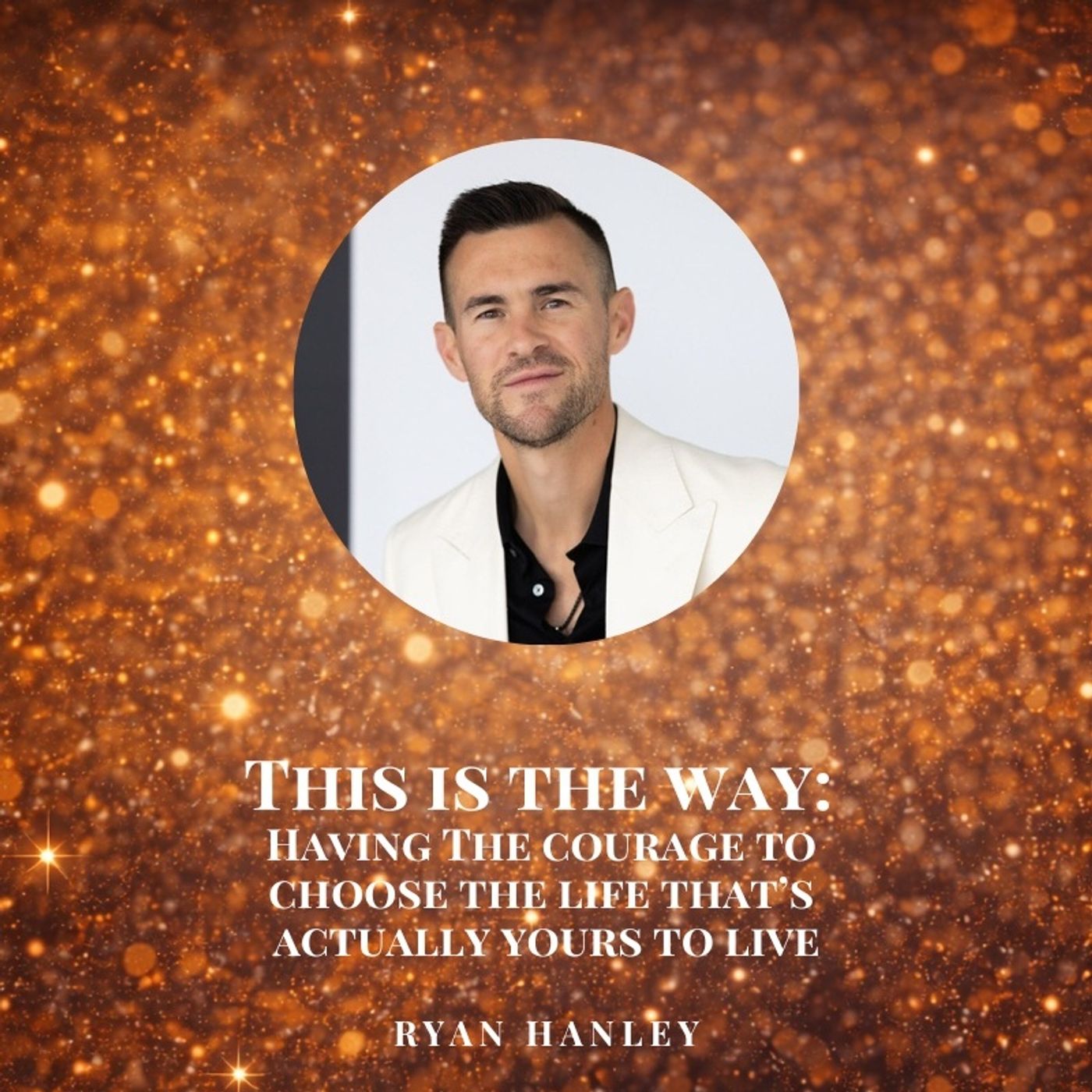
This is the Way: Having the Courage to Choose the Life That's Actually Yours to Live
You can build a life that looks successful on paper and still know, deep inside your soul, that something isn't right.
Ryan Hanley knows that feeling at a visceral level.
In 2017, after years of chasing more of everything - more opportunities, more speaking engagements, more recognition, more success - Ryan collapsed backstage at a conference. From the outside, his career was taking off. Behind the scenes, he was exhausted, anxious, disconnected from his family, and beginning to realize he might be succeeding at the wrong game. That moment forced a question that changed his life:
Do I even want to become the person I'm working this hard to become?
In this vulnerable conversation on Quick Before You Forget, Ryan and Ty explore burnout, purpose, regret, fear, success, faith, parenting, and what it means to build a life that actually belongs to you.
Ryan shares why clarity (NOT MORE) may be what you're missing, how comparison can distort your definition of success, and the simple 90-second PEAK framework he uses to stop a spiral and return to the present: Presence, Energy, Awareness, and Kalibration.
They also talk about choosing risk over a life that feels safe but wrong, raising children who are watching more closely than we realize, the power of mentorship, and Ryan's belief that fear isn't proof you should stop. Instead, it's simply a data point.
Because burnout isn't always about doing too much. Sometimes we're exhausted because we've spent too long becoming someone we never actually wanted to be. And you don't need an entirely new life.
You need to come back to the one that's already yours.
If you've been feeling burned out, lost, successful-but-unfulfilled, uncertain about what's next, or like something in your life simply doesn't fit anymore, this conversation will meet you where you're at, give you a quick and necessary hug, and kick you in the pants to get started with building the life you are actually meant to live.
Meaningful Moments
00:00 — Meet Ryan Hanley: Finding clarity in a noisy world
01:00 — What does it cost when your life looks right but feels wrong?
04:00 — Succeeding at the wrong game
07:00 — The backstage collapse that changed Ryan's life
09:00 — What happens when you don't live what you teach
12:00 — “This Is the Way”: creating a code for your life
15:00 — Faith, clarity, and finding peace with who you are
17:00 — Are you living in reality—or somebody else's definition of success?
19:00 — The Ferrari problem: comparison and feeling like you're never enough
23:00 — Reality → accountability → responsibility
25:00 — What you focus on is who you become
27:00 — Finding the work that actually makes you feel alive
29:00 — How clarity makes saying “no” easier
31:00 — The PEAK Method: a 90-second reset when you're spiraling
32:00 — P: Are you actually present?
33:00 — Energy, awareness, and recalibrating yourself
35:00 — How to stop one bad moment from stealing your entire day
37:00 — Why needing to recalibrate doesn't mean you've failed
39:00 — What Ryan would tell his 22-year-old self
40:00 — Growing up poor and knowing he wanted something different
42:00 — When the “safe” life isn't your life
44:00 — The cost of spending a decade being who you think you should be
46:00 — Choosing alignment even when the next step is scary
47:00 — What Ryan's sons have taught him about becoming who you say you are
49:00 — Parenting as accountability
53:00 — The +1/-1 philosophy of mentorship
55:00 — “I'm dying” → “I'm alive”: choosing excitement over fear
57:00 — Ryan's unexpected music of survival: Wu-Tang
1:00:00 — Ryan's Megaphone Moment: courage and Ralph Waldo Emerson
1:02:00 — Fear is a data point—not a verdict
1:04:00 — Fear vs. excitement and choosing the bigger life
1:05:00 — Ryan's upcoming book, Easy Mode
Ryan Hanley's Song of Survival is all things by Wu-Tang Clan.
Connect with Ryan or book him to speak at your next event: https://ryanhanley.com
0:00 Fear and excitement light up the same neural pathways in your brain. If you strap on one of those brain scanners and you feel fear or you feel excitement, your brain looks exactly the same, which means you get to choose whether something is exciting or it is fearful. It is a choice. You're not feeling fear. You're having a data point that you get to choose whether that data point is positive or negative. But either way, it's just a data point. You're not wrong for feeling fear.
0:55 Ryan Hanley, welcome to Quick before you forget. Oh my gosh, it's such a pleasure to be here. I am so excited for my friends to get to know you better. So you guys. Ryan is a amazing ted X speaker. He's a keynote speaker, He's an entrepreneur, and he's a founder of Finding Peak, where he helps leaders cut through noise and build lives and businesses with ruthless clarity. He's delivered more than four hundred keynotes, built and sold a company, and is known for challenging high performers to stop chasing someone else's version of who they should be and what success looks like. What makes Ryan. Different isn't what he's built, it's what he's walked away from and what he's learned about choosing your life on purpose.
1:39 So what this conversation Ryan looks like is a walk through the past, present, and future of your life. How does that sound? Sounds great? Well, I'm grateful you're here, and normally I start a little different, but I wanted to start today by asking kind of a two part question that is based in that challenge and that clarity that you offer people. So what is the cost of chasing a life that looks good on the outside but feels off on the inside is the first part, And the second part is when in your life did you realize that you were succeeding at the wrong game. I think the cleanest way to describe the answer to your first part of your question is regret. And I know there's been some work done recently around regret being a positive thing.
2:26 I've read that. I think it's nonsense. I think regret. You can try to spin regret to be a positive, but I don't think anyone feels it that way, and I don't think regret is always acute. I think it's portrayed as acute in stories or in movies, I oftentimes think that we feel regret and how it presents in our lives is this. Dull haze. And I don't want to get too nerdy on you, but nerdy in general if anyone has ever studied science or space in particular, there is this cloud that we can't see past. When we point our telescopes into the sky, we hit a certain point, it becomes fuzzy and gray, and we.
3:12 Just can't see past that point. And I feel like when we aren't, when we feel unfulfilled, when we feel disconnected from our purpose, our meaning, which is very easy to do and all of us will experience at some point in our life, it is this dull, fuzzy haze that we can't seepass, that we don't understand, but it's there, and it's It manifests as frustration, as discontent, as dissatisfaction, as lacking stillness, lacking clarity, and it presents in many different ways, but it is this base, this base part of us that we just wake up with every day and we maybe can't even articulate, but a lot of times it stems from regret. I'm not doing X, I should be X, I wish I was X, or why and I'm not.
4:05 And there's a lot of different reasons for that. But when I work with someone, if we can get we can start to at least name what that is. If we can bring words to it and start to actually examine and understand what it is, then we can start to figure out how to get past it. It's not always regret. Sometimes and I don't mean to go too far off context, you can pull me back in here, but sometimes we manifest regret for things that we don't even actually want. And I think that is, unfortunately, one of the downsides of social media and the way media is presented today and the world is presented to us, is that no matter what you do, it's not good enough.
4:51 And that's a very difficult thing for people to do. I went so long, I forgot the second half of your question. Well that's okay. So, I mean, you said a lot of good and important things in there, but my question was how it kind of impacts you, Like when did yel that you were working and succeeding at the wrong game. Yes, so I had a very clear moment in twenty seventeen, I had risen from a local independent insurance agent. Not that there's anything wrong with that, but you know, just local business person. And I had done a few things that had put me on the national stage in one particular industry.
5:31 In this case, it was the insurance industry. And I started to get asked to do keynotes and speak and do workshops. And it was it. It was the closest thing to the high of playing sports in high school and college that I could possibly feel as an adult. I felt like I had lost that I didn't know how to get it back. And then all of a sudden, I'm on stage telling stories and interacting with an audience, and I'm like, oh my god, I love this. And I basically I bought into the whole thing. I bought into the hype, into the social media, and I said yes to everything, and I was on the road.
6:15 You know, I think one year I did in twenty sixteen, I think I did something like fifty plus keynotes. And I had two young kids at home, and I had a wife at home, and I was just I was on another planet. I was not being a good parent, I was not being a good spouse, I wasn't being a good caretaker or steward of my family. In my portion of that role, I basically was completely captured by this notoriety that had kind of seemingly come out of nowhere for me and I and I convinced myself, and this is where I get to the regret part. I had convinced myself that I. Was doing it for my family.
6:56 I was able to mentally justify leaving them, leaving them far too often, being disconnected, not present at home, working sixteen eighteen hour days, you know, and in some cases just just work to work, just because I thought that's what you had to do if you wanted to be successful. And in twenty seventeen, I had ground my my I had stress and anxiety because I was trying to become this thing that I had in my mind that I thought I was supposed to become. And at the same time, I knew in the back of my mind that I wasn't taking care of my family at home and there was tension, and I wasn't working out, I wasn't eating right.
7:38 I was masking the feelings of pain or frustration or dissatisfaction that I had across the board with you know, with alcohol, not necessarily in like I'm getting bombed all the time away But it was like that I need to have a drink every night. To like calm myself. Thought that you start to it starts to like link into your brain, so like, I'm not taking care of myself. I was the MC of a conference in twenty seventeen called Elevate, and before I went out to introduce the closing Kenot, I passed out backstage like literally sack of potatoes to the floor and it was basically exhaustion. I was, like I said, I wasn't taking care of myself. I was filled with anxiety, filled with stress, and my body just couldn't take it. And it was a huge wake up call to say, like do I even want to be this thing that I'm trying to become? And then I started to have massive and this is where the regret comes in. Then I started to say, well, all I've ever really wanted to be was a great role model for my boys, and I want to be a good husband and I want to you know, these are these are characteristics of who I want to be, and I want to be a good steward of the people who listen to the things I say and I'm not even living the life that I would coach people on
9:09 and I would tell people that, you know, help and help and trying to help people do the things that could make them happy. I wasn't living that life either, And I'm like looking in the mirror, going, you're a freaking joke, like you you're you're telling people, you know, hey, we need to you know, have a fit mind and have a fit body, and be good stewards of our family and our finances and these things. And not that I didn't do. Pieces of those things, but I was excusing away my discipline and commitment to the ideals that I put out into the world. And that just smashed together three minutes before I walked on stage to introduce the closing keynote, and it was a revelatory moment for me. I you know, it wasn't like I was down and out forever. I was not able to bring it. That last speaker on I was, unfortunately, and which was which then caused embarrassment, and I said, this will never happen again. And it was that that changed the course of my life. Was that moment, and I said, if I'm gonna be able to sit here and talk to you and share my story with your audience and with my own audience and my own podcast and in my keynotes and in the people that I coach, Like this seems obvious, but like I got to live that life, Like can't I can't be helped, you know, I can't know the path and not walk the path. That it's completely disingenuous and disconnected.
10:33 And unfortunately, I believe in soul. I'm I'm a Christian. I believe in all these things. And I think eventually the universe cuts up to you and says that that disconnect cannot last forever. And I don't love that I had to hit that moment to learn the lesson. But at the same time, here, you know, almost a decade later, I'm glad it happened because anytime I feel myself straying, I just go back and relive that moment and the feelings that I had and said, you promised yourself, you made a commitment to yourself that you would never put yourself back in this position, get back on the path.
11:14 And you know, that's one of the ways that I recalibrate today. Wow, thank you. And what I heard in that story was that things were fractured, like things were I've broken as the wrong word fractured, I'll stick with fractured. And were you okay? Like what happened after you passed out? I drank some water, sat there in embarrassment of only my own design, you know, no one else, No one even knew other than the three or four people that were backstage, and all of them were very good. But I just kind of sat. I sat off to the side where no one could see me, and I watched the closing keynote and pulled myself together, and then as soon as the conference was over, I did all the thing, you know, I'm talking to people and all the things that you do when you're kind of in that position and making sure things were handled right, and kind of acted as if nothing had happened that day, just to kind of get through it. It wasn't like there was another thing intrinsically or systemically wrong with me from.
12:16 A health perspective. I had just it was just a point where the stress of the two days of being there, the not taking care of myself, the other anxiety that I had been carrying and ignoring for so long, it just you know, smashed together in that moment and my body just gave up and you know it. Luckily no long term effects other than, you know, a moment in time in which I can look back to and say, this is what your life becomes when you don't walk the path. And it's why today. And I know if anyone's a fan of the Mandalorian, they I've heard this before. But I close every piece of content that I create today with the phrase this is the way. And I use that as a reminder not necessarily to my audience but to them as well, but mostly to myself of like, what I love about the phrase this is the way in the Mandalorian if anyone's have watched it, and if you haven't or you're not a Star Wars fan, that's fine, but essentially, yeah, you should. But I get that some people just bucket sci fi in general, so that's fine. This phrase essentially is an acknowledgment of a code between these people, Mandalorians.
13:33 And what I love about Mandalorians is that they are not a race. You can be in the in the world, in the universe of Star Wars. You can be any race from any planet. You can be everything from royalty to a homeless person on the street, and if you choose to walk the path, you can be a Mandalorian, which means which I love because I think it brings together the idea that you know, we're not black, white, yellow, purple, brown, we're not man woman, whatever you know we are. It is a it is a mentality. It is a mindset that brings us together. And in their case, they had a code a a and whether you want, whether whether the code was easy or hard, you you.
14:18 Walk the path. And when when their way of acknowledging that to each other was this idea of this is the way, and so so it is my I've kind of taken that and brought it into my own world, to the idea that I have this set of beliefs and code that that I've found when I walk the path, the way yields satisfaction, piece, love, connection, fulfillment meaning purpose and whether that's easier hard, that's the way and you just have to live it. I love so much about what you just said. I am a Star Wars fan, and I did get to take a picture with Mando when my family was in at Walt Disney World a couple weeks ago, so that was really cool and his armor and everything. The detail is insane, but there's so much in what you said that resonates for me personally, just with you know, being on this path. You know, I talk I'm also a Christian, and I talk about God's yellow brick road for me and that is my path. And I'm increasingly grateful for all of the incredible people shapes color sizes all of the incredible people that have been part of my journey and joining me on this path. It's just been such a blessing. So you know when you were it makes me wonder like when you were feeling fractured on the path and you talked about like the beliefs and the code,
15:51 Like what beliefs do you have that helped you get through and kind of piece together to piece things back together again and get really clear after that happened to you with with you know, painting and stuff. So I have always struggled with organized religion. I was raised an Irish Catholic. I still go to Catholic Church. There's a lot that I like about the Catholic Church is a lot that I don't and I've always struggled with it. But my relationship with God and connection to God in particular has always been very strong. And in the moments where I. Have cultivated and purposely cultivated my relationship with God have been the moments in which I've found the most clarity.
16:34 Piece. And by peace, I don't mean like sitting cross lagged in the grass. I mean. A level of comfortability with who I am and the way that I operate and how I present to the world. That's what I mean by peace, Peace in my soul, not necessarily peace in my actions. Right, you can be at peace and at war at the same time, internally at peace and externally at war. And by war I don't necessarily mean dropping bombs. It could be your company is struggling and you have to You. Got to bear down and que quote unquote go to war, right, You got to dial in and get after it. Like some people UH struggle with with violent rhetoric, I guess, But to me that's just being weak willed and weak minded, not necessarily so. The where what I found to answer your question, Jordan Peterson was rising.
17:27 To prominence at that time. And for whatever anyone thinks of Jordan Peterson, I would will hold him in regard my entire life because his work at that time, he was doing a massive amount of YouTube videos. He was on tour speaking and he wrote this book, Twelve Rules for Life, and twelve Rules for Life was a pivot moment because when I read Twelve Rules for Life, it taught me a few things. First and foremost. That we have to live in reality. And I think a large portion of the disconnection and discontent that we feel daily is that we're not living in reality.
18:13 And this can take a lot of different forms. So when I'm working with someone one on one, which is my preferred way to work with people, oftentimes the first hurdle we have to get over is that they have some perception which is not based in reality, that is driving them, that is causing, that is causing whatever the issue is. So what does that look like? That could be. I have a good job that I worked hard to get. I have a spouse that is still in love with me. I have kids that I appreciate. Yet I wake up every day as if I'm a failure. Well, what's happening there? Because in reality, you're making six figures, you're paying your bills, your kids are doing great, there's food on the table, your spouse and you are able to communicate and get along, which is not an easy thing to do. I mean, living with any other adult human is incredibly challenging, let alone the dynamics of a marriage.
19:16 Regardless if it's you know, straight, gay, whatever, it doesn't matter. When two humans live together who love each other, there's a lot of challenges there. And by all accounts, if you were to take a manifest of the of the of your life, you're doing great. Yet you saw someone that you went to college with is driving a Ferrari on Instagram, and somehow you feel like your life isn't everything that it should be. And I was talking. I actually had a client a few months ago, and I tried to cycle off of my clients. I try not to be there for that. Unless they need that and want that, that's fine. But my goal is to help course correct and then let them let them learn, give them the building blocks to learn these things out on their own. So this was in the fall, you know, and and this was his issue. He he he had this.
20:07 He's like in his head, he kept saying, I'm using this for our example because this is what his problem was. He's like, he's like, oh my, you know, I've done all these things, but I you know, I don't. I don't have like a nice car, say like, And I'm listening to him going, I said to him late. Okay, so let's let's just let's just let's just take this in for a second. You like your job, yeah, I like my job. And you make good money. I'd like to make a little more, but I make good money. Okay, fair enough, get that. But you make good money, yes, okay. And you and your wife, yeah, you know, we get along. We're did we do well? We still we go on date nights. I okay, great, that's that's nice. Kids are doing good, kids are kids are thriving us. Okay. So your big frustration, the thing that is keeping you up at night, the anxiety that at the feeling, the the the drinking too much, the the eating crappy food, the extra twenty five pounds that you don't like about yourself that you're carrying around, that's because you don't have a ferraw I said, bro, you live in New Hampshire.
21:04 What are you gonna do with a Ferrari in New Hampshire? Like you can only drive it like three months. Out of the year. There's potholes everywhere, So it's not that you can drive it fast, Like I live in the Northeast. That's not a knock on New Hampshire. If you live in Northeast, there are poddles everywhere. You can't drive these low rise sports cars anywhere. Because the roads aren't nice enough. So like, what like what do you? What do you? What are we talking about? Let's come back to reality for a sec and let's ground success in reality. Is it what maybe the Ferrari isn't the thing? Like, is it just that you feel jealous of this person? And now we can start to do it, but we have to operate. We have to come back to what's actually happening here on the ground. And it looks another way in so much as we believe the world should work a certain way that it doesn't.
21:48 Right, So so. There's this version, this external version, where we we believe we should have things that we don't have. Okay, there's this other way that we distort reality. And these are the two most common in which we believe the world should operate in a way that it doesn't. As in, well, I've been here for twenty years, I should get that promotion are you the best person for the job. Did you tell them that you wanted it? Did you like what did you do that was exceptional that would make you the absolute choice for that job? Just that you've been here, Like you think that this way it works, that's not the way the world works. Right, Like, there's all these ideas that we allow into our lives that aren't how.
22:30 The world works. We don't have to like the way the world works. We don't have to like the fact that hierarchical organizations produce more results faster than flat organizations they do. Okay, now, it doesn't mean that by saying that. It doesn't mean that the person who's towards the bottom of the hierarchy shouldn't have a voice or that they should be treated differently. Those are different issues. But we fight. We take this idea and we're like, everyone should be equal. No, that's not the way reality works. That's not the way reality works. It sounds great. I can appreciate the ideal. I'm a Christian. I believe in God's eyes, we are loved, we are equal. I morally desire the same thing that you are asking for. Unfortunately, in the reality we currently operate, and maybe there's a different reality somewhere on some other plane of existence, which this isn't true, but on the one we currently sit on, right, there needs to be someone who's accountable throughout the organization for the various aspects and things happen.
23:31 There needs to be someone in which the buck stops. And that's essentially what a well run hierarchy does is it allows levels of accountability and the ability to pass off work and bucketize and put people in teams. And these things are very important. Yet we'll start a company and create some crazy flat structure and then wonder why nothing gets done and why everyone's unhappy and knowing what's going on, and no one knows who the boss is, and no one knows who should make a decision, and it's like, so to pull this all the way back in the first thing that I learned, and the first thing that I said to myself was I am I am going to ground myself in reality, knowing that if I make bad decisions, those decisions are my fault, because that's reality, right. I made those decisions. I decided to have too many drinks that night.
24:24 I decided to not work on that project till the last minute I decided to not acknowledge this team member who did a great job, and now they're feeling, you know, misunderstood or unheard or not appreciated. Those were my fault, my responsibility, right, So it was reality first, and then reality leads to accountability. Accountability leads to responsibility and from there, now we can launch into the places that that are actually going to produce real results for us. So from there you start to work on things like getting clear on things like how because you you you walk through those steps and I think that a lot of that work is required before you can even start to work on being clear. So when you start to work on being clear, you know you you, I think you say, like you, people don't have a potential problem.
25:18 They have a clarity problem. So what does that actually look like in real life? And how do people then level up past what those other steps and that other work that we were talking through. Yeah, not to not to stroke Jordan Peterson too much, but he has I do have. His book here somewhere. I was going to look for and try to grab it out, but I do have that book, and yeah, it's exact cure. So he says, he says two things on on. So I have this phrase. It's written down on a white board that's in my office, which is in the room next door. What you focus on is who you become. And a lot of different versions of that. It's just the version that I use, short, concise and works for me. Essentially, the words the origin of the words sin is not negative.
26:06 It's to miss your mark. So he says two things on this particular topic. One, if you have, if you have the option aim up right, don't aim down, don't aim across, Aim up because if you aim up, even if you miss, you're going to be in a better place than you were right. Aim up. And to sin is simply to miss the mark. That's all it is. It's to miss the mark. So that what that means is you take a shot and you miss. All that happened was you miss the mark. But keep shooting right, aim up and keep shooting, but be clear on the target that you're going after. So I believe, and this was my fault. Until twenty seventeen, I had no idea what I was aiming for. I was just more, more, more social media, flowers, more this, more time, more work, more more just giving me what I wanted to be who I actually was, what I stood for. I was just it was whatever would get me more right, whatever I need to say, whatever ill. I hate talking about social media tactics, but people would pay me. So are you to talk about social media tactics? Sure I'll show up and talk about so. I don't care about it beyond I'm you know, at the time, was relatively good at it, et cetera. But you know, oh you want me to talk about this, Sure I'll do that. Oh you want me to do this consulting gig even though I can't stand.
27:24 Sure, I'll do that. Because more there was no aim. I was all spread too thin, all over the place, no idea who I wanted to be? Okay, after twenty seventeen and I started to learn these ideas, and really I'd heard some of these things before, but it was Jordan's work and then many others that when I really went down this path, that started to frame to say, Okay, you're going to become the thing that you spend the most time on. So what is that then going to be? If I'm going to be a social media tactics speaker, then then that's the thing I need to spend time, except I don't spend time because it's not what I want to be. What do I want to be? Well, I figured out through I started going to therapy at the same time, and I figured out something about myself that I kind of knew but could never put my finger on, which was.
28:17 I've never gotten satisfaction out of my own achievements. I feel the most satisfaction in supporting or helping or guiding others to their achievements. That's where when I sit back and. I see, say, there's a guy in the insurance industry who's doing really well in the speaking circuit. Insurance industry is my native industry for those listening. And when he first he did his first gig and he wasn't real happy with it whatever, and I had been speaking for a while. He called me and we started working through and talking about what did he really want to be? Who did he want to be, Who did he want to be on, What was the energy presence, What was the performance that he wanted to give, What was the outcome that he wanted the audience members to experience?
29:09 What were the emotions he crushes? Now now it was his work, right, I would like you know hopefully I guided him in this path, but it's his work. Watching him today, I would rather he gets the great gig and dominates and see him do amazing than necessarily myself, because I'm so happy for him and feel so much satisfaction in helping him get there. So once I learned that part about myself, and that will be different for everybody that's just me, then I can start saying, well, what is the work that allows me to do that thing? If I know my passion, what I could show up every day is supporting and being of service to others, then how do I start to build my life towards that? And then every decision from that point was does this help me serve others?
29:57 Does this help me serve. Men who have stagnated in their career, given up on their lives, are not the husbands or not the fathers that they want to be, that are not the leaders that they want to be right, that feel this sense of frustration and regret and pain, and are thus not the positive community members, not the positive influences on the people around them they should be right. So now every decision moves me towards that thing, because I have clarity and focus on it. And when someone comes to me with, hey, we'd love you to come speak. About social media tactics, I can be like, I very much appreciate it and thank you, but no, that's not me, and that took me a long time to get there.
30:41 Today I feel very dialed on that. I feel very confident in what my mission is on how I show up every day. But man beforehand, like today versus you know, the day before I collapsed in twenty seventeen, I was a mailstream. I was an absolute disaster. Even though outwardly people would have said I was very successful, internally I was not. So I resonate a lot with what you said, and the thing that I heard in a word was impact and that being a really important kind of almost like a core value part of your mission. And one of the things one of the ways that you bring that to life for people is with your becoming undeniable work.
31:26 We can't go deep on it right now, but we can scratch the surface for some folks that need to start, like they're at that twenty seventeen version of you, and they need to get they can't get to hear tomorrow. But what is the first thing what is something simple and replicable in one move, one idea that you can tell us or share with us about how you start to take that step and how you become undeniable. Gotcham, I'll give it. Give you guys. An acronym. It's PEAK. PEAK. It stands for presence, energy, awareness, and calibration with a K because I didn't want to spell peak.
32:08 With a C. So when I find myself in a moment where when I find those feelings of dissatisfaction, disorientation, frustration, maybe even a bit of anger, regret, self doubt, I just walk myself through this exercise. Am I present? So it starts with p am I present? Am I present right now? Or am I living in the future of the past? Okay, if I'm living in the future, I'm most likely saying why don't I have this? Why am I not this thing? If I'm living in. The past, it's regret, right, it's I should have, you know, I wish I would have if only's, Oh my god, if only's destroy more quality thoughts than anything else.
32:56 Right, Am I present in this moment? Because when we're present, it's very tough to be dissatisfied, frustrated, or angry when we're present in the moment, because when we're present in the moment, we're taking in the experience that we're having. Right We're interacting with the world right now. We're not allowing our brain. I don't know if you've ever read The Untethered Soul by Michael Singer, but I believe that we are not our brain, and we are not our body. We are our soul. And when we are not, when we are present, we are living in our soul and understanding that our brain and our body are just vessels to connect with this plane of reality. Right, but we are. So we're here right now. I'm here with you. I'm watching your body as it reacts to the words I'm saying. Right, I'm present in this moment. I'm not thinking about things I have to do later today. I'm not thinking about what happened this morning. I'm right here with you and present.
33:40 Very tough to be dissatisfied in the present moment because you're operating, you're living, connecting. Okay, am I present? What is my energy level? Am I low energy? Or am I high energy? If I came into this call with you and I was low energy, then my expectation cannot be that I'm going to give my best performance right because I'm low energy right right now, and it's okay. We all cycle through different level Sometimes you're low energy and you did nothing wrong, it's okay. But when we understand what our energy level is, we can respond appropriately awareness. What is happening around you? Are you aware of your position and what reality is in this exact moment? And then finally, we need to have a simple way of recalibrating back to where we want to be.
34:26 So for me, that's the. Serenity prayer. So everyone can have a mantra. It could be Buddhist, it could be whatever works for you. There's literally no right or wrong answer to whatever your recalibration is. So what will happen is I'll sit down and be like, am I present? Nah Man? I've been thinking about all this crap. I have to do this afternoon all day. So instead of thinking about the call them on, the sales, call them on, or thinking about this podcast, or thinking about something I need to create or etc. All I'm doing is thinking about the future. Okay, come back in, be present. Okay, where's my energy level? Got a good night's sleep? Fairly high energy. Okay, that one's good awareness. Write what's going on? Where am I right now? Am I in a good place? Where's my mental feeling some regret?
35:11 Okay? Let me settle myself and recalibrate back to the center. God grant me the serenity to accept the things I cannot change, the courage to change the things I can, in the wisdom to understand the difference. And I'll say that two, three, four times to myself. And once I'm done right, I'm now at least back to a place where I'm not spiraling. Once I get back to a place where my heart's not maybe pounding, I'm not feeling as much anxiety, I'm a little more calibrated. Now I have a clear mind to actually start to understand how to fix more of the systemic problems. Because we can't get to fixing the systemic problems if we're constantly on this runaway spiral. We have to be able to recalibrate ourselves back to center. So by understanding our presence, our energy and awareness for the moment, and having a simple way of recalibrating right, we can get back to that place and catch our before we spiral off the planet.
36:02 Right, that's kind of phase one. That's like your your triage, your your your battlefield triage of having a way of not allowing yourself to waste an entire day because you got a text message from you know, your your parent who's bugging the crap out of you for something, who just told you something that frustrated the heck out of you, and now all of a sudden, you're completely spinning off and you're missing all the things that you need to do for that day. Because what's gonna end up happening is you spend all this time thinking about things that didn't impact your day. You're gonna get to the end of the day and you're gonna have even more regret because you're gonna feel like you've wasted eight hours. And now the negativity is compounding on itself. So the first thing we need to have is and again, peak is what I use is a simple process that this is. This is ninety seconds, guys.
36:49 I'm not talking about sit down, cross your legs and kumbay a. Right. This is a I'm sitting at my desk. I'm in the middle of a zoom call, right, and maybe I turned my monitor off for quick sec even though I'm still listening, and I just sit there for a sec. Become present, you know, say you say your recalibration, feel your energy come back, be more aware of your surroundings. Turn your camera back on, and now you're back to go. Now you're not spiraling off. I will get back to that thing. I will respond to that text message. I will deal with that email when it's time to deal with it. Let me get through my day, let me handle this thing right now. If we can keep ourselves from spinning off the planet, we can address the bigger issues. But if we're constantly chasing that thing, constantly out ahead of ourselves and unaware and un present, then we almost have no chance.
37:36 So it's fixed. It's have a simple tool, right. This is to have a simple tool for recalibrating yourself and getting yourself back to being present in the moment. And you'll find even. If you have to do it three four times during the day, Right, that's okay. It's not meant to fix all your problems. It's meant to keep you from spiraling and losing more time. I'll tell you what I could have used that the simple tool, like six years ago. I mean, thank you for that gift, because it was truly a gift, because I think that it's easy to remember. It's I think you can walk through it, you know, like you said, like ninety seconds or so, and it's simple enough that I think, you know, you could use it seventeen times in a day, and darn it, I probably will.
38:24 So sometimes you need to write, and that's okay, I think not to jump in, but I think what you just said is really important. Like I've done a tremendous amount of work on myself, tremendous, and I every day is still a battle like and again this goes back to living in reality. Like my expectation is no longer than every that any day is going to be perfect. There's no such I don't even expect to have a perfect day. If a day goes amazingly well and I find myself on a beach with a drink, you know, next to someone that I love, having a great time staring at the ocean. Weather's beautiful, that's amazing. I love that just like anyone else does. But that's not my expectation.
39:06 My expectation, right is that the day is going to have really good points. It's gonna have messy points. There are gonna be days that are just all mess there are gonna be days that are all amazing. And my goal is to stay as focused as I. Can on the thing that I that that that is my purpose and my meaning brings me joy, contentment, satisfaction, right, and just recalibrate back to that whenever I spin off the fact that you need that that there's a day where you need to recalibrate seventeen times is there's nothing wrong with you. You're not broken. Your life isn't a problem. You're not a mess. I hate when people have negative self talk around Oh my love, I'm just a mess. No, you just you just you just haven't you haven't been taught the.
39:50 Tools yet to to help pull yourself back in, because everybody feels this every day. So and I can say that for certainty because I'm twenty seventeen. By all ourward measures, people would have said that my life was this massive success and I felt terrible about myself. So it's okay to have those feelings, but we need be a little more focused and start to develop the tools to bring ourselves back in. But just because you have one moment during the day. You're not wrong, you're not broken, you're not a mess, there's nothing wrong with you. You're just a human being. And that's what reality looks like. Wow, Like, I yes, and I want to know, because I know we're not focused on the past, right, but I do want to know. Like, what would you tell twenty two year old Ryan if you could.
40:40 Take more risks? I played it very safe early in my life. I have a weird My life has had a very weird journey, and weird, I should say weird. I find it. I use the word weird just to mean interesting. So take that vernacular for what it is. I sometimes we will. Share it with us, tell us, tell us the weird story. I want to hear it. And I think you can news whatever word you need to. So. I grew up in a very poor, very small town in the middle of nowhere in upstate New York, in the woods, and we used to say you could leave the doors open at night because the criminals lived in our town. They didn't rob in our town. And I remember, as early as age twelve walking from my house to a friend's house and I had a very distinct moment. There was one there one street light in the middle of town, and I lived in town, and I was walking and I remember looking at there's three gas stations around this at the street light, and those are the only businesses in the whole town.
41:34 And I remember walking through, going. I got to get out of here, like this can't be my life, Like this can't. Be my life. Like I got to figure it out. And I became very entrepreneurial. I would collect bottles. I would wake up at five point thirty every morning and walk the streets of my town collecting bottles out of the recycling bin. So I could make forty bucks a week. Right, I mean we were port this is what we were, and uh, you know, got job. I started working at thirteen. I've worked since I'm thirteen years old, through high school, through college. I've always had a job since I was thirteen. I became dedicated to school because I saw grades as one way of getting out of this town. I became dedicated to sports. I played college baseball because that was another way to get out of this town.
42:23 Right, So I had I took risks, I pushed. Every ap class like and then I graduated college and it was like I forgot what got me there, and it was I went to I need to get a job with a big company and a salary and a four to oh one k and health benefits and I need to have the security of a big company. And I went to work for this company in Washington, d c Rsmagladery, which is a large accounting firm. At the time, they were the fifth largest in the country. I have no idea where they are now. And there's nothing wrong with Arsema Gladua. Perfectly find people treating me great, so not knock on them. But it was just very safe.
43:04 It was very boring for me. For me personally, I wasn't an accountant. I was a math major, so I was like in a consultant there. Essentially, I was like an interpreter for the nerds because I kind of knew numbers, but I also knew people, so I like was like the guy that they would talk to to communicate with the accounting nerds translah. Yeah. And I hated every second of it. I worked there for four years and it was nothing again, nothing against our scene glad I hated every second of it, and I was like, well, maybe it's maybe it's this company, so then I were and work for American Express and worked on the seventeenth floor of man I think it was World Trade Center three was the one that didn't fall.
43:44 I had to walk by the hole every day, which was depressing, but. Same same scenario, perfectly fine job, perfectly find people, perfectly find company. Hated every second of it. And I played this very safe. And then I went into insurance and I was very safe and everything was safe and it. Was and I was miserable. And it wasn't until again, you know, twenty seventeen that I had that moment of just like a large part of that. I think what I was feeling at that time was I felt like I was capable of so more, so much, so much more, and like that's why I was just grabbing at everything.
44:27 It was like it was like a rubber band. After having played it safe for almost a decade up to twenty seventeen, it was like a rubber band snapping forward like I played it safe for so long. Then I started to get this. Little bit of notoriety and people wanted to know what I thought, and they asked me on podcasts and asked me to speak and it was just like, oh, this is my chance, let's go And if I felt I feel like if I could go back to twenty two year old version of me and if I had started, if I if I had focused more on taking the risk to live the life that I wanted, which I always wanted to be a performer. I always wanted to help people. I love being out on stage. I love being I love telling stories and I love telling jokes. I love this right commun communication. If I had gone into that thing, then even though it would have been more challenging, no safety net, all those things, I believe I could have worked through a lot of those issues and I wouldn't have had to have a moment where I collapse with two small children, you know what I mean at home and a spouse who doesn't want to talk to me because she hasn't seen me in months because I've been on the road, and all these kind of things, right, Like, so I would love to go back and tell that guy, like, whether you're you know, everyone's like every yeah. I hate when people are like, or go back and tell my younger self like everything's going to be okay. I don't freaking know if everything was going to be okay, right, but I think I would have enjoyed that life more. You know, for a decade of my life post college, I didn't enjoy it.
45:54 I didn't enjoy my life. I didn't enjoy it. I was living this version that I thought I would supposed to because I went to a top thirty school. I went to Universus Rochester, and when you come out of there, you go get a big job with a big company, and that's what you do. And you know, and that's not me, That's never been me. And I knew that wasn't me, that wasn't the me that got me to that moment. And I allowed myself to believe the lie, not living in reality, that I could change who I was because that's who I was supposed to be. And you know, probably my biggest regret in life is that I allow myself to believe that narrative.
46:34 We've all been there, though, Like we've all chosen that safety over taking the risk, and sometimes it's forced, and sometimes we choose it either way. It's not always easy to decide, you know what, Actually, I'm not going to be safe anymore. I'm going to try the scary, big thing that scares the crap out of me like starting a podcast that nobody, you know, nobody knows about right now when I am currently unemployed in making zero dollars, I'm going to do the thing. And you know, it's it's scary, it's absolutely scary, and so so so what I heard you say so worth it. And you know, you avoid that regret then and you avoid you know, but and what I heard you say without saying these words is that you are living in alignment now and you were living in disalignment before misalignment whatever the proper English is. But that's powerful, Like, and I want to encourage anybody that's like the listening or watching to know that it's a decision you get to make today. You can decide to figure out who you are right now today and use that information to direct your path and start, you know, work through the peak and just work through all of those things that mean they may they may be scary, but you do it anyway because then you don't have that regret. So thank you for sharing that that whole story. And you did light up a little bit when you talked about your two boys, So I want to know what they've taught you about all this.
48:04 Oh my gosh, so. They're probably the thing that I'm the most proud of in my life. I think. I like being around them. I don't think everyone can say that about their kids. I think that's another reality. And it doesn't mean I like them every moment of every day. I mean, they can be a little shits, but but seven yeah, oh my gosh, jeez. I mean they can do things and say things and just but they also.
48:46 They are such a reflection, like our kids are such a reflection of us, right you You if your kids are not fun to be around, you made them that way, you know what I mean. You allowed them to become that thing. It's one of the beefs that I have. And I don't mean to go slightly contextual here, but it's one of the beefs that I have When people talk talk crap about younger generations, Jen the millennials are this gen z is this, jen Elfha is this? And I'm like, how do you think they got that way? Do you think that you know this like this like entitlement that everyone's like millennials are entitled? Then, frankly, I think they are a little entitled. But it's not that they didn't It's not like they woke up one day and they're like, I choose to be entitled. That's not what happened, right, So you know, they were the environment, the morals, the values, the constructs that were put in front of them, how they were taught, how they were incentivized. Right, That's how they got to this place, and and and that's broad stroking, but but you get my point. I do so when my kids, what I see is the ability to say is a constant reminder that I have a greater responsibility than myself, which is launching them out into the world, not with the tools to be the whatever version of them that they choose to be.
50:06 Right. I don't get to dictate their life to them, nor do I want to dictate their life to them, Nor do I want them to be reliant on me at ten and twelve. I don't want them to be reliant on me. I certainly don't want them to be reliant on me. As as adults. So my job and. The and what I love working with them on is helping trying to put the building blocks in place for them to figure out who they are and work towards becoming that thing. And you know, I think it starts with our relationship with God, starts with our understanding of family, of responsibility, of personal accountability, and all these all these building blocks, now I think, done right, it also forces us to become the best version of ourselves. So I see them as a constant reminder that I can never fall off the path again. Is if my son at twelve sees me become a lunatic again, where I'm chasing, you know, chasing opportunities and scatterbrained and you know, missing baseball games and you know, needing to pop a beer every night to like, you know, land the ship or whatever stupid excuse we make for some of these things.
51:17 Like that's who he's going to become. Is that who I want him to become? Do I want him to become a frustrated, anxiety ridered, stress induced lunatic who doesn't understand his place in the world because he saw his father that way? Like no, right, I see. My responsibility is to show them as much as I can and as fallible as I am, the path. And that keeps me on the path. And and now certainly my older son and my younger son's getting there too, he's ten. Now we're stir old enough, we're starting to hold ourselves accountable to each other. Right, so now old enough to see me do certain things and say, Dad, you said you weren't going to do that, and and that that level of relationship and connection.
52:10 Is I cherish it more than anything else in my life. So you know, I think that I constantly, you know, it's a constant reminder that this my life is not mine. The day you have children in your life is no longer your own, and I think I think that's I think this whole narcissistic, secular, materialistic world that we've devised, where you have parents who care more about the bling on their wrist than the lessons they're teaching their children is an absolute travesty, and I think we're doing our children a huge disservice. When you decide to have children, your life is not your own anymore. It's not it's not your own. It never was your own.
52:53 It was always God's. But I think that's hard for a lot of people to swallow, especially people that are secular. And that's fine. You don't have to love God for God to love you. But amen, certainly, when you have children, your life is not yours. Your Rolex doesn't mean shit. Your ferrari doesn't mean anything. What matters is are you building a foundation for your children to launch themselves into this world the. Most successful way possible? And I don't know. It's the greatest challenge of my life. They're frustrating. It doesn't matter what you want them to do. They're their own people. You could teach them the same lesson a thousand times, they still have to learn it themselves. Although I did have this funny moment the other day where I'm sitting in the car and I don't know, we got music going, and we're driving to one of their basketball games or whatever, and the younger one said something and the older one spins on him, and he's sitting in the front. He turns around and looks at the younger one and he's like, you know, da da da, He says. It's like I'm gonna forget exactly what he said today. He hits him with this little ditty right, and I was like, ooh, he is listening, like that's the stuff I he I would normally say, like you know what I mean? It was like some like profound thing that I had probably barfed on them like a thousand times yes, And I was like, oh, so they are listening, okay, and so taking this all the way to business life, like like we need like these relationships seem natural, This mentor mentee relationship that you would have
54:24 your children seems very natural in a familiar environment. And you know, through through the work that I'm doing in the podcast and the various things that I do, I'm trying to help adults understand as well that that type of mentor mentee relationship is just as crucial adult to adult as it is adult to child. And we need to have mentors and we need to have mentees. And you know, there's just this, uh I think it's called plus one minus one philosophy, which is we need to have one person our lives who is a step ahead of us in the place that we want to go, and we need to be mentoring one person who's a step behind us. And what that creates is an apprenticeship relationship.
55:10 The way that people used to learn how to shoe horses in build cathedrals, and you know, basically every job up until the last about one hundred and fifty years, right has been very much an apprentice relationship. And we need to be just as dialed in our mindset, mentorship as we are in our craft. We have a lot more in common than I realized. My boys are ten and twelve, and that same thing has happened to me, and it's been really cool. The coolest example of it I've already shared on the podcast more than once, but I'm going to share it again because it's so special to me. It was when we were on our way up in a scent of a three hundred foot drop on Mako at Sea World, which is this like hypercoaster, and the drop is insane, and my twelve year old, he was young at the time, but my twelve year old goes the whole way out.
56:02 He was so nervous. My ten year old is like the brave, reckless one that's had three broken bones and burned his face and the whole thing. He's just like the He's I'm not worried about his level of pushing boundaries, right. The older one is not. He's a little more safe. It's a little more you know, nervous. So the whole way he was so nervous. And then we're going up this thing and he's freaking out. He's like We're dying. I'm dying. I'm dying. I'm dying. I'm dying the whole way up. And then we got to the top three hundred feet in the air and or just start dropping and he goes, no, I'm alive the whole way down, and I was like, oh, they listen. Like that mindset shift of like choosing excitement over fear happened in real time in that moment. I was so grateful.
56:43 So I love when we have those moments as parents, when our kids show us that they are listening. Sometimes I don't love it because it's like, oh, shoot, they're listening, but also yes, we love it because yes, they're listening. So it's just it was it was cool to hear you talk through all that because I was hearing myself, and that's I took a guess with your it's ages with the six seven reference, but I'm spot on, and you know, it's just it's really cool. So I know your time is precious and I'm so grateful. I have one more question, and I do want you to talk through your podcast and all the exciting things that you're doing, but well, two more questions is that, Okay, do you have time, Yeah, I do. Okay do you mentioned music in the car with your sons and that made me happy because music is one of my tools in my tool belt that I used to build my unreal life.
57:25 What is your song of survival? Do you have a song that you go to in a moment when you're grounding yourself and maybe working through the peak in your head. It's not a song just about anything from Wu. Tang that's shocking and not at the same time. I love it. My older son was seven. My my relationship to curse words and inappropriateness is probably not age appropriate. But I also. I just I don't necessarily believe in sheltering our children.
58:05 I mean, I think there are some concepts that are above them, especially some hyper sexual kind of things explicitly. But like I think we I think we sheltered. I think we shelter our kids too much. I think we pretend like they are not completely aware of everything that's going on in the world. So so that that's a different topic. But I at seven, he was seven, my owner almost five, and they started wanting to have control of the music and their mother. Who I'm divorced. We've been divorced for four years now, but we get along grade it's not combative. But their mother listens to like teeny bopper top forty, like trap nonsense music that like I feel as soulless.
58:49 I just I can't listen to it. So I was like, I'm not, I can't listen to this crap that these kids listen to and stuff. Like I can't. I can't. I don't want to listen to this in the car, like I I'm driving. I don't want to have to listen to some nonsense you know whatever the new with Bruno Mars what Team Bopper song is, Like, I don't want to do that. So I was like, okay, guys, we're gonna start going like Discotomy by Discott, We're gonna start working through and for better or for worse. The first album that we worked through was Wu Tang Forever. And then we went to thirty six Chambers Uh. Then we did some of their solo stuff, and then we moved on to jay Z and then we.
59:30 Went to This Is Really Bad. But we went to n w A because I wanted to show him West Coast stuff and Snoop and so we then then then we started to mix in the classic rocks, so like, I think they have a pretty firm affinity, like on their playlist, which I think is funny because if we share a Spotify account so I can see their playlist, Yeah, it's like Metallica. Then it'll be like a Wu Tang song. Then it'll be like some you know, Kendrick Lamar. Then it'll be like the beat, and I'm like, I feel like I did something right, Like I did right of everything else, but this eclectic, crazy, eclectic classic rock, you know, kind of like my younger one loves Nirvana, loves Nirvana. I'm like, I think it's amazing that there's a ten year old out there whose like favorite song is like smells like teen spirit.
1:00:18 Like, I think that's fantastic. That's job mentioned accomplished. Yeah, it's mission accomplished. Yah. So something for me though, if I like, if I need to get kind of jacked up or you know, like it's my get after it, it'll be something Wu Tang most likely. I love that so much. And the eclectic nature of the kids music is great. Yeah, yeah, yeah, so good. One last thing is the megaphone moment. So if I handed you a megaphone and kind of everybody in the world had to listen to you for you know, thirty to sixty seconds, what would you say.
1:01:06 I'm gonna give you a quote from Ralph Waldo Emerson, one of my favorite writers and thinkers of all time. Same. It's from his uh, it's a short story. It's called self reliance. God will not have his work may manifest by cowards. Amen. Whatever that looks like for you know that, whether it's working for a nonprofit, being a stay at home mom, being a stay at home dad, being a good parent, being a good whatever that thing is, whatever that thing is, that work that needs to get done, He's not gonna have his work may manifest by cowards. You gotta get after it. You gotta do it, You gotta do the thing.
1:01:54 You gotta be willing. You know. It's gonna be my last tattoo, which will be right inside inside part of my bicept. I have a sleeve from my wrist the top of my shoulder, and the last part is inside of my bicep, and I just started mapping it out, and. I always knew that that's what it would be. Since since the day I read that quote, I probably say to myself every day sometimes multiple times a day, certainly every time I feel fear for something. Anytime I feel fear, I will remind myself God is not of his work may manifest by cowards, so get after. It doesn't mean that you're gonna win, but if you're cowardly, you've got no shot.
1:02:37 So what is well? Go down swinging. I needed that. I mean, I love well, I love Ralph waldew Emerson as well, and I knew that. I like, I know that piece of writing, and it's it's so true, and fear is not an easy thing to work through. So it's super helpful to have a very specific fear related mantra. So I'm going to add that to my list. I have a small list of mantras that I say regularly, and I don't know why I hadn't had that one on there sooner, So thank you, sir. Can I give. Finished one thought on fear before we were of course, I just want to say this for anyone that this helps, and I'm probably saying this as much to myself as anyone else. The fact that you feel fear is nothing more than a data point doesn't mean you're bad, wrong.
1:03:29 It doesn't mean that you're lacking. It doesn't mean that you're worse, it doesn't mean that you're not blessed. It doesn't mean anything. It's simply a data point. It is your brain and your body saying this does not align with survival. Simply a data point. That's all it is. We have to remove our emotional attachment to fear. It's very difficult to do, and I misin struggle with this all the time. So this is not me sitting on high telling you some how I have zened out. Fear from my life. Right. I have that mantra because I feel fear often, and it reminds me that it's nothing more than a data point.
1:04:14 And we can get so caught in because we feel fear somehow I'm wrong or bad or not worthy, and none of those things are true, none of them. I've done four hundred plus keynotes in my life. I feel fear before I step on stage every single time, every time. Actually, I probably feel more fear today than I did when I started, because today there are expectations on my performance. When I first started, it was like the fact that I was there was enough. Right now, people have seen me enough times that there's a certain level of expectation of performance. So I feel fear that I'm not going to live up to that level of performance. Right, and but then today I also now have the tools, I guess you could say in this case of Mantra, to be able to say it's just a data point.
1:05:01 And lastly, fear and excitement light up the same neural pathways in your brain. If you strap on one of those brain scanners and you feel fear or you feel excitement, your brain looks exactly the same, which means you get to choose whether something is exciting or it is fearful. It is a choice. You're not feeling fear, You're having a data point that you get to choose whether that data point is positive or negative. But either way, it's just a data point. You're not wrong for feeling fear. I have been saying that you know, and it's the coolest thing that I know and that I live that I wish I could share it with everybody. Is that that fact, that scientific fact of what you just said, you get to choose, and that is the in many ways to me, that is the door to a bigger life.
1:05:57 Like that is that is right there, like you opening that door and deciding to walk through it anyway? Is that that's the path? So this is the way, and thank you because goodness gracious, I've been I've been finding the right moment to talk through. That's that energy of the science. It's like it's not we're not making it up, we're not being woo woo, We're not you know, like it's literally science. And thank you for that. So where can people find Ryan? Where can we book you for speeches and all the things? Oh well, I appreciate that so much. Ryanhanley dot com just my name Ryanley dot com is a great place to start. You can find the podcast. I have a book coming out. We started writing it, but I signed a contract with ben Bella Books. So Simon, that's amazing, very excited. Good job, you have a great publisher.
1:06:46 The book's gonna be titled Easy Mode How to find your Edge, build your life around it, and remove everything else. So essentially what we talked about today, And. If you want to learn more about the book, follow on in the journey all those kind of stuff. Ryan Hanley dot com is a great place to start. Beautiful, thanks, thank you again. Ryan. I am so pumped follow all of that online. So appreciate your time today, your energy, your words, your soul, all of it. So we will see you guys next time on Quick Before You Forget. Thank you for being here with me today on Quick Before You Forget. Please like, share and subscribe as that helps the show so much and I really appreciate it and I'll see you next time on Quick Before You Forget.