Show, Don't Tell: Kelly Madrone on The Secret to Telling Stories People Actually Feel
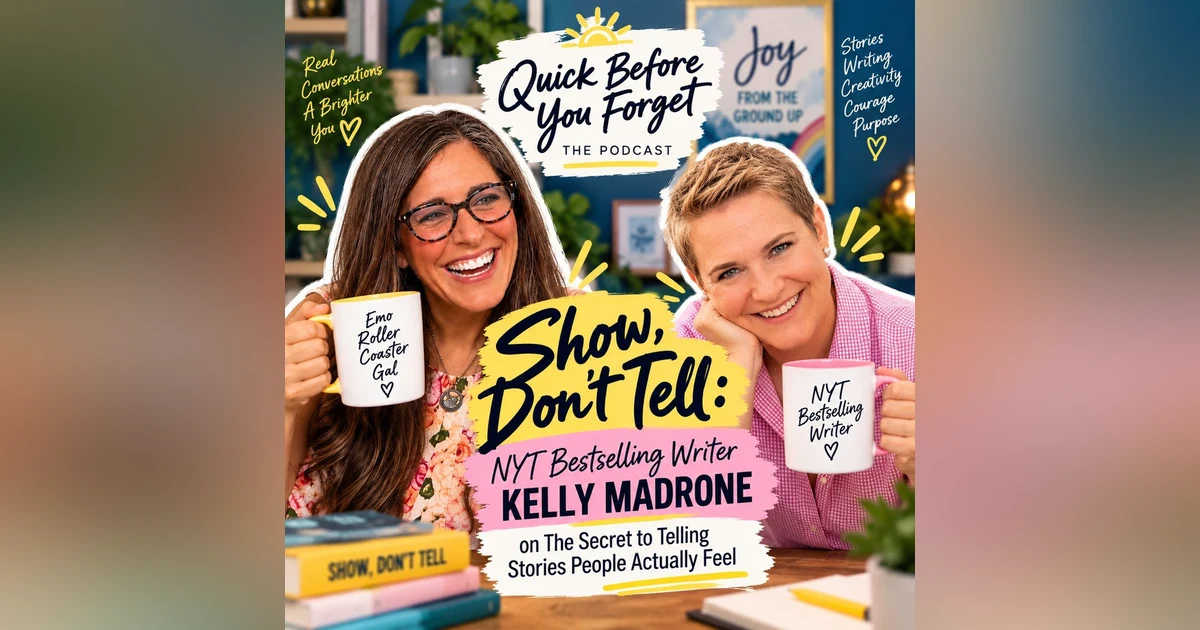
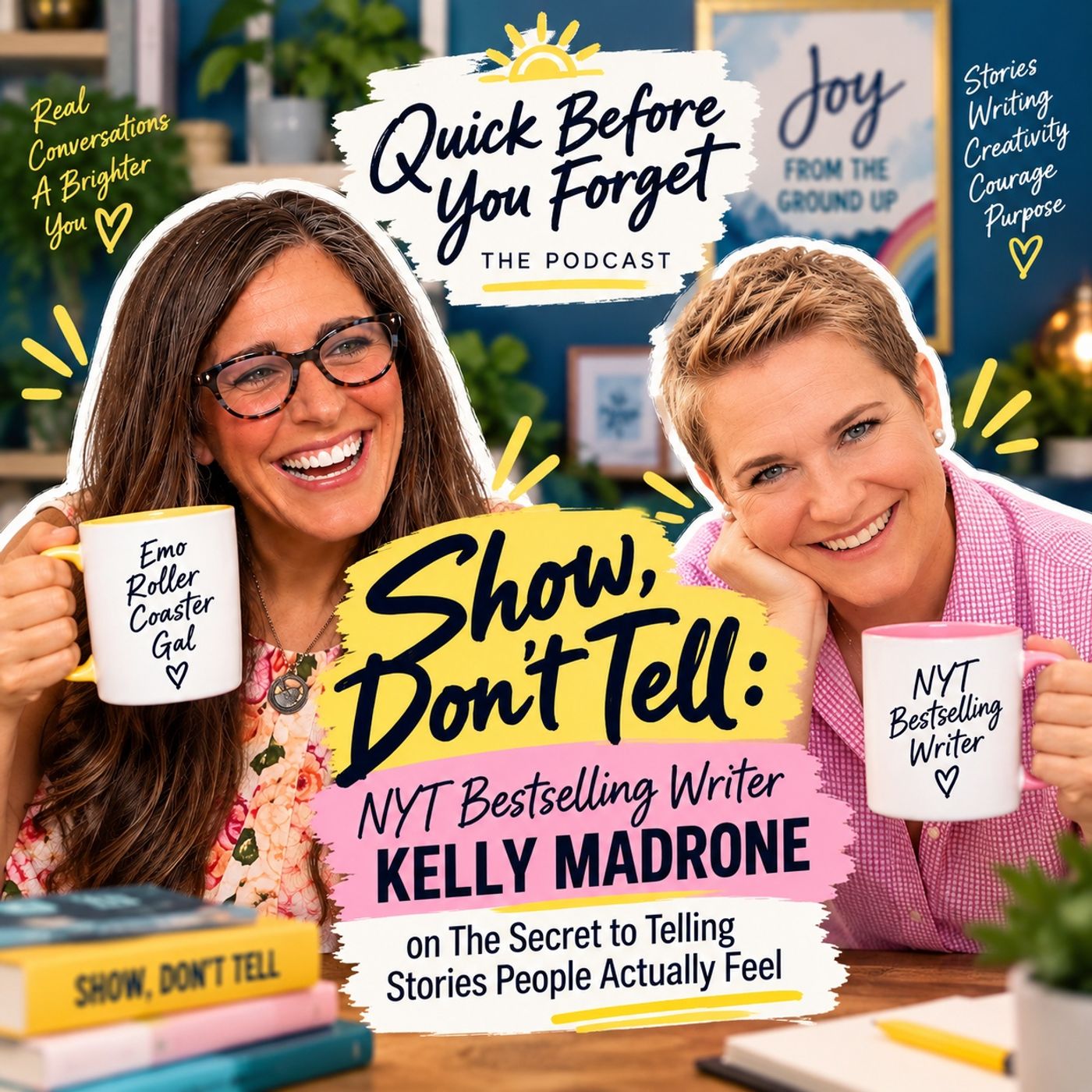
The difference between a story people hear and a story people feel is in how you tell it. New York Times bestselling writer Kelly Madrone knows some things about how to breathe life into the words on the page. She’s spent nearly 30 years in...
The difference between a story people hear and a story people feel is in how you tell it.
New York Times bestselling writer Kelly Madrone knows some things about how to breathe life into the words on the page.
She’s spent nearly 30 years in publishing as a writer, ghostwriter, editor, collaborator, and writing coach. And the day before we recorded this conversation, Kelly learned that the memoir she co-wrote with Jaclyn Smith had debuted at #9 on the New York Times bestseller list.
Though we do celebrate that massive career win with a great story involving a cactus, a fall, and a bear with some pears, this episode is actually about everything that happens along the way rather than "how to become a bestselling writer."
Because we're friends here, we go there.
The rejection. The rewrites. The falling down...sometimes literally into a cactus. The intentional, often hard choice to keep showing up. And the realization that the dream isn’t only the peak moments.
It's that, sure. But also it is learning how to tell the stories we collect along the way in a way that makes another human being lean in, connect, and feel something.
That’s where "Show, Don’t Tell" comes in. Kelly explains the difference with one line I haven’t stopped thinking about since we had this conversation: “I knew what happened, but I didn’t know how he lived it.”
That is this episode of Quick Before You Forget. Learn more about Kelly and her incredible work at https://kellymadrone.com/show-dont-tell
0:00 Obviously, we know we know where it ended. So like spoiler alert, New York Times bestseller. Yay. Yeah. Where did the day start? The day started and it had been, you know, kind of a tough, tough couple months, a tough after a tough couple of years in one way or another. I mean, there are lots of great, great things. You know, I always say life is a mixed bag. Rarely is it one or the other, even if one is kind of more predominant at the time. But yesterday morning I woke up and I'm an early riser, but I don't usually get up at four. But my wife was waking me up and she was frantic. And what I found out was it was because there was a bear in like leaning in our window.
1:07 Kelly Madrone, welcome to Quick Before You Forget. I'm so happy you're here with me today. Thank you, Ty. We've been talking about this for a minute. And so, you know, I'm always happy to talk to you on podcast, off podcast, anywhere, texting, whatever. For a minute. Yes. For a minute. We've been friends for a minute and we need to. I need to like back us up because my friends don't even know who you are or why we're here. And that is super important to me. So please, Kelly, will you kind of just level set with us, walk us through a little, like your, your 92nd, who is Kelly? I should have an elevator speech prepared and I don't, that's, that's, I feel like that's the realm of my clients. Um, so I am a writer first and foremost, it's pretty simple, but I do, um, ghost writing, collaborative writing. I'm an editor.
1:56 I'm a writing coach. And I came to this by way of, I've worked, I've done something in books and writing for my entire career, which is about 30-ish, 30 years now. I always say like, this is my origin story is I sold my very first story at the age of seven to the York Dispatch newspaper. And I got, you know, it was like one of these kids, elementary school, like, little fiction stories that I wrote and it got published and they sent me a dollar and they sent me a junior press badge and I still have them. So I was like, I'm hooked. I, you know, I, even though I contemplated all kinds of like fantastical careers, like architect and artist, even though I never, I've never was ever good at art growing up, I always wanted to be a writer. That was always my first love. And so when I, um, graduated college. I got into, I did a graduate course at the University of Denver in publishing.
2:56 And then I got into publishing, working on the editorial side as an assistant, as we all start out in publishing. On the editorial side, you're an editorial assistant. And then eventually got promoted, became an acquisitions editor, developmental editor, et cetera. Got into corporate communications for a while. And then I looped back out and became a full-time Um, freelancer extraordinaire doing writing and ghostwriting and collaborating with authors. And along the way, I did write and publish two of my own books, which were self-help books for teens. Um, but mostly in the last many years, I've been writing for other people and helping other people with their writing. And I should say I focus on nonfiction, which includes memoir.
3:45 et cetera. I write some fiction myself, but I don't really work in that area for other people. I feel like you way undersold yourself. Should I say what happened yesterday? Yes. Yes. Tell them what happened yesterday. I was one of the first people I texted because she's been part of this ongoing saga. So I was in a meeting and I came out and I checked my phone and there was an email from the assistant of a prominent editor at a prominent publishing house And she said, I kind of quickly scanned the subject line and I'm like, is this what I think it is? And she said, you know, we're on the New York Times bestseller list and we're debuting at number nine. So a book that I co-wrote, I'll say, like with Jacqueline Smith, who was, I mean, if you're a Charlie's Angels fan, you know exactly who that is. If you're a mini, if you grew up in the 80s, you know who that is. But I was a huge Charlie's Angels fan.
4:43 But I worked very closely with Jacqueline Smith on her memoir. It's right on the shelf behind me. Really proud of it. And I will say I absolutely adore her. She is all kinds of wonderful. She's incredible to work with. And I want the best outcome possible for everybody I work with. But we got, like, close working on her book. And I just, you know... we became friends and I just want, and I knew she was really taking a risk because she's in the, she's a private person. And she says that in the book, like she kind of had to be persuaded to write this book. And she kept saying to me, she's like, is anybody really going to be interested in this? And then we were like, yes. So she's also very modest, but I, I really wanted this book to do well for her. And because we were both really proud of the work, we loved it. We, we really liked how it came out. And so to have that kind of acknowledgement is just amazing. And for me and what I do, it's the best thing that can happen, you know, for my authors, but also for me, because, you know, when you work with New York Times bestsellers, and I have worked on New York Times bestsellers before, but this is the biggest role that I've had in actually writing one. So, yeah.
6:04 What did it feel like? Walk me through getting that email. That's the thing. Like you think you say you got an email and you skimmed it and it said these words. What were you feeling? What was going on in your heart? I'll tell you. I was thinking a couple of things about it this morning. That, you know, you've heard me do this before because I do some trail running and I think that there are a lot of comparisons between writing the writing life and trail running. So there was a huge event yesterday. weeks ago called UTMB it's like they call it the Super Bowl of trail running and the guy who won it won in record time and I heard this great interview with him afterwards and one of the things he said was this was a four-year project for me like I focused on no other he did other races but he didn't focus on winning any other race and it was like the day-to-day going out there he said you know all the work was all the runs that I did by myself or with this running partner he goes out with and it's like all the choices about what's he going to eat all the choices about all the days that, you know, they have their own fun to them because you're doing something you love, but the experience of like winning a race is happens so seldom, you know, even if they do well, how often did they win a race, let alone one of the most prominent races in the world. And so I think writing is a lot like that. I mean, I work on many books. Most of them will never be on the New York Times bestseller list in part because of volume. It's, And in part because the New York Times bestseller list, people think it's like straightforward. You sell X number of books, you get on the list. It
7:36 is a very complex calculation of how these numbers land and when and what types of sales. And so I know that there's a lot that goes into it. And I knew that Jacqueline's editor had prepared her that it's like, we're hoping for a New York Times bestseller, but... You know, like any good editor would say, like the fall is kind of the busiest book release time and it is the most competitive time, essentially. So we'll see. We'll hope for the best and we'll see. We'll do our best. So getting that message, what was great about it was the meeting that I had come from, it was an in-person meeting, which I don't have a lot of because I live in a rural area. So like no clients live here except for this one person. who's really special.
8:27 And we were talking about some really powerful things. And we're talking about his memoir that I'm going to be working on. And so I came out of this meeting, just feeling really wonderful for having, you know, reconnected with this person who I adore. And then I opened my phone and I see, and I read it. And of course I'm immediately trying to call my wife who's not available and I'm calling and calling and calling and she's like all busy. But it was just like, Wow. I had to let it sink in. It was like, we did it. We did it because it's one of those things. Like when I published my first book under my own name, I was like 23. It was the first book that I worked on, you know, in that, in that, in any real writing way, it was my own book. And I thought I'm a published author. And that meant something different back then we didn't have self-publishing. So you had to get a publisher to buy your book. And that was its own process. And I thought, wow, I felt happy and I felt relieved. Like I did it. I can always now say I have a book that I did.
9:34 And I felt the same way. Like I have a, I have a black belt and Taekwondo. And when I got that and I got that in my late twenties. So I was like the, you know, an adult, I wasn't like a little kid. And I had, so I went through a different mental and physical process doing that. And when I got my first degree black belt, I thought, wow, I did it. I put in all this work and I got there. And I kind of had a similar feeling because it's like, once you are in that role and you've worked on a New York Times bestseller people look at you differently in the industry you know because I've literally had jobs where authors have wanted to hire me but the editor came in and said she doesn't have a New York Times bestseller And I want your book to have a, like, they didn't, the editor didn't know me. They'd never worked with me. They didn't know what I could do. And I was just getting dismissed because of that. And I always said yet, yet. And I will, you know, I did. I believed that. And the reason, and, and I will go back to this guy who won this race. He said, I trained to the point that it felt inevitable that, I put in the work to the point that it felt inevitable. And to me, I'll say it's not 100% me. It's circumstances, it's luck. I have an amazing mentor in this business who used to be an executive editor for Random House.
11:04 She herself has just retired as one of the top ghostwriters in the business. She has advocated and put me in front of agents to give me opportunities. Like, you know, I don't know where I'd be yet in my career without her. So it's all those things. But the backbone is the work that you put in every day. So I just felt like if I keep showing up, I'm now in front of enough people. I'm now doing enough of the kind of work at the level that I need to be doing. Always room for improvement. Always room for more. That it feels inevitable. And like I said, I worked on New York Times bestsellers in different capacities. So I've been parts of that team before. And I will say working with, Jacqueline and her platform and her, like how loved she is. I just knew that the, that the, the things were there, you know, the pieces were there that it could, you know, it could come together on this one. So yeah.
12:06 There's a lot to unpack there. A lot. Like, first of all, my mind went to what's next. Are we going to Disney? Like what's good. What are we, how are we celebrating this magic? So bookmark that question. And you jumped right over your books. Like you jumped right. You're like, I wrote these books and I was 20 and it was great. And I was published. What are your books called? Yeah. And also props to you for being a super theoretical or a super, you practice what you preach because I'm riveted. Like I'm like leaning in. I, you're a great, such a good storyteller. And like, not like a, like a theatrical person per se, but really good at storytelling because I heard what you were saying about the runner. I knew you were going to circle back to it and what value there is in that story. He's, he trained to the point it felt inevitable and like that's life.
13:05 Like that's legit. Like you said, it was a lot like, like writing, but it's also a lot like life. Like you train and you do the reps and you do the things until it feels inevitable. And that's, that's so cool. And the thing, and as with like other things still have to line up, you know, like at the same race, a whole bunch of people were wiped out with stomach flu, something you really have little to no control over, you know, that could have happened. So there's always, I will say God's grace, there's whatever the universe conspiring to support you. Like, however you, you know, if you have a space for that, there's that, and there's other people. And there's always other people involved. We call it Gus around here, Kelly. It's Gus. God, universe, source, spirit. Kelly knows this because we've talked about it, but I'm just making sure our friends know his name is Gus and Gus does his thing, right?
13:52 That's right. On Gus's time and in Gus's way. And your job is to keep doing your thing, right? And keep showing up. You said the words, you keep showing up and you keep putting in the reps and you keep believing. I think it's a mindset thing too, though, because you have to, like you said, you have to believe that essentially the impossible is possible. And that's what the runner did. That's what y'all did with this book. And that's so stinking cool. And what are the titles of your books? So the first book is out of print now. It's called Young People in Chronic Illness, True Stories, Help and Hope, which is a pretty straightforward title. That's the title that the publisher chose. But it was, I went out and I did interviewed kids with chronic illness because growing up at age 12, I was diagnosed with Crohn's disease. And at that time, because I'm old, because I'm 52, at the time when I was 12, 40 years ago, that was a, now everybody knows what it is. But back then people didn't, it was, nobody had heard of it.
14:53 The doctors at the time said, this is a very rare condition. And it was, you know, it wasn't underdiagnosed. It was a very rare condition at the time that has become very common. But being a kid with chronic illness and coming back to school and having been diagnosed with something, I didn't know anyone else who was having that experience. Now, world of difference. My book now would have been, you know, like it would have had to have been a totally different book because unfortunately that's, it's common for kids to be struggling with some different physical things. But at the time I saw, this was when I was at the University of Denver Publishing Institute. We actually got to interact with different publishers and And we were supposed to, for a project, create a book pitch and pitch them on it. But only I decided to create a real book pitch and I pitched the woman and I followed up with her and I followed up and they bought it and they ended up buying it. And so we did that. And then I want to say it's maybe seven years after that. I wrote a book for a self-help book for LGBTQ teens that is still out there and going. It's in its third edition. When it first came out, it was called GLBTQ survival guide, you know, for lesbian, bisexual, transgender. We flipped it now because now the common, more common acronym is LGBTQ. So now that's the title. But yeah, that's, that's still out there and it's still going. I don't think we'll do a fourth edition. I think, you know, like, I think other people have now picked that, picked up that mantle.
16:23 There are a lot of resources out there. There are a lot of issues that I don't think it's for me to get into. And, And I'm a lot older now than when I first wrote it. So the gap between, even though I feel still very connected, I love writing for teams, et cetera. I think, you know, again, other people have that. And so I don't imagine doing another edition, but that's what, that's. I will tell. Right. Yes. You never know. So I have been banned. Banned books. Banned books week is coming up in October. So I've been banned. My wife got me a shirt that said banned author. Nice. In multiple states. So yeah, I am a corruptor of children. Please, please make a clip.
17:13 We don't say that on this show. Kelly, we need some PR training. I know. Yeah. And we keep showing up. You mentioned, to pivot, you mentioned that you live in a rural area. And I want to rewind to yesterday at 4 a.m. Because you told us the fun, amazing story about the New York Times bestseller. And I think what's really cool about that story is that you started your day on the ground, literally. Yeah. And I think that like literally, and I want to, I want to share that story with our friends because I think that it's an important metaphor for all of us and something for all of us to learn from, lean into and fully adapt into our lives. So talk us through, obviously we know, we know where it ended.
18:05 So like spoiler alert, New York Times bestseller. Yay. Yeah. Where did the day start? The day started and it had been, you know, kind of a, a tough, a tough couple months, a tough, after a tough couple of years. in one way or another. I mean, there are lots of great, great things. You know, I always say life is a mixed bag. Rarely is it one or the other, even if one is kind of more predominant at the time. But yesterday morning I woke up and I'm an early riser, but I don't usually get up at four, but my wife was waking me up and she was frantic. And what I found out was it was because there was a bear in like leaning in our window and So the sad thing is it's so dry here. There's nothing for the bear seat.
18:50 So they've come down from the mountain. They're getting in everybody's trash or whatever. And we're doing our best to just secure things, but it's really sad, but this is how desperate they are right now. So we had our kitchen window open like an inch and the bear ripped out the screen, opened the window, leaned in and held himself to some pears and understandably my cats freaked out and they woke us up. So, Morning goes on. I, you know, feed the animals as I always do have my coffee, go downstairs and feed our foster kittens that we have that we're taking care of for the local shelter and then go to take the dog out for a run. And so I do live in a rural area and it's very hilly. And this is, this dog is why I got into trail running, which I'm grateful for.
19:33 But so we go out most mornings and I was running and, you know, I got hit a toe grabber, the rock sticking up, just caught my toe. And I flew and I, you know, slid on the rocky ground into a cactus. Into a cactus, which is a very. New Mexico experience and so you should know people picturing cactuses in New Mexico it's not Arizona Arizona has the saguaro cactuses which are the big tall ones we have little very short cactuses that are like all over the ground um with with like little prickers in them that are as dense as sewing needles. So that is how I started the day, but, and it's fine because I was able to, in that moment be like, okay, this is what's happening right now. I was okay. I mean, I, yes, I got scraped up and I did have to take care of some cactus prickers, but, um, the day went on, you know, and I, the day went on. And that was actually one of the things that I was thinking about this morning when I was, I had mentioned, I was reflecting on like how life is and writing or like trail running. And I was looking down at these like, you know, great, you know, trail rash scars that I, or, you know, marks that I have from that fall. And along with some other like small scars that I have from other falls, because it's inevitable when you're doing this, that you've got, you're going to fall sometimes again. Hello life.
20:57 Right. That. I think there's a lot of writing that leaves, you know, like you get, you get beat up in this. If you want to be a professional writer, like if that's how you want to make your money and you're living, at least doing what I do, the books and the stuff you're going to get trail rash, you're going to fall a lot. I mean, it's going to be like, you can just count on it because it's the rejections. It's the, the job you really want. And they decided to go with somebody else. It's the, you know, the feedback and the rewrites and the, you know, like you, most of the work is not like, you know, child of the eighties again, murder. She wrote, I loved the opening of murder. She wrote because Jessica Fletcher would just like tap away on her typewriter flinging out ages, you know?
21:49 And I thought that's what it's, that's what it's like to write books, you know? And it's not that way. It's not that way. I have some typewriters. I have a collection, a small collection too of old typewriters. Cause I just love that, you know, analog tactile, tactile interaction. And I blame Jessica, Jessica Fletcher. Do you have one? I have, I just have a picture of one up there, but yeah. Yeah, they are. They are beautiful. Yeah. But it's not like most of rating is not like that. You do get in flow. You do, you do like, you know, have these moments where you're like, oh, I really like how that came out and it feels really good. They can also be closely followed by an editor being like, I don't really like that. I don't think it's working and just cut it, you know, and you have to, you have to be okay with that if you're going to stick around and do this work.
22:39 So you've got to like kind of have this balance of being really attached to it and really caring enough to do your best, but then being able to just let it go and move on to the next thing, you know, to the next draft, to the next, project to the next whatever. So. Well, you've gotten. It's not for the faint of heart. No, no, you've got, and you get, you get beat up. I mean, you just, it's just, it's just part of it. Yeah. And you know, it makes me honestly curious because you, some time has passed since the first publishing or the first published book. And I'm honestly curious what you think that version of you would be most surprised by. or relieved about or challenged by? Thinking back to you that published that book at 23 and you now, what would she be most surprised by that you've learned over the course of time?
23:38 I'm going to guess, and this is something I shared with you before, is that idea, and I'm sorry, but I'm going to, again, I'm sorry this comes from trail running. I'm really not obsessed with trail running, although My kids think that I am, my family thinks I am. So I can't imagine why it's only come up 17 times in the conversation we've had. My mind is kind of lately on this, you know, and as, as a writer, I will like work an analogy. So my, it's just kind of like, my mind is just going there right now, but there's the saying that it doesn't, it doesn't get easier. You just get better at it. So I thought 23 year old me thought it would get easier. You reach a point where people know your work and they just hire you. You get so good at it, you don't get that many edits.
24:28 That it just gets easier. Or that it gets easier to get critiqued. It gets easier to get rejected or whatever. And I would say it doesn't. I don't think it does at all. That's my take on it. Maybe some people do feel it gets easier. However, my capacity to receive that as part of the world that I've chosen to be in and work in has grown along with my skills, along with my appreciation. So, I mean, I think it would be disingenuous to say it hasn't gotten any easier, like because there are things like once you've done a certain amount of, Once you've actually even worked in publishing, it's extremely helpful for me that I've worked on the editorial side because I know the production process.
25:20 I know how things go. But once you've done a certain number of them, you've been through the copy edits, you know, you know kind of how it goes. Just having that awareness and expectation that you can set does make it easier. Like starting a new book is always hard. You never just start and dive in and just Jessica Fletcher, you know, and then we're done. Um, there is a, there is more easefulness, I think, around the acceptance of how hard it is. Yeah. And an appreciation that I, to me, is worth the work. Because I do think, I feel like, yes, I can say, I could pull out my work. And I think that this is just like, everybody would agree, I'm a better writer now than I was in the past and thank God because I work really hard at it. I'm always, you know, there are always people for me to learn from always. There always will be. And that's like something that I love about this work is I will never be as good as I could be. And I think that's a frustrating idea for some people. And then there are people like me who I find that amazing. I find that engaging. I find it because I'm going to want to be with this thing for my whole career, if I can, you know?
26:42 So I love the idea that I'll never, I call it like the mountain with no summit that I'll always be on the mountain somewhere and I'll be higher at different points, you know, but I'll never, there's never, there's no point where I'm like, now I'm, now I'm the best writer I could ever be, you know? So yeah. That's a lot of real life Advice to like a beyond writing that, you know, you're on the mountain and you should appreciate the view, right? Like you, you, you can stop and appreciate the view, regardless of whether you've reached the so-called summit, you stop and appreciate, like, look around and say, Hey, this is pretty cool. Like I, I, and we've learned a lot and look how far we came.
27:22 And you look down and you're like, wow, that's impressive. Right? Like that's, we are 23 year old Kelly and now we are New York times bestselling Kelly. Like that's really, that's really, you. Know, and I think that there is amount of, you have to stop periodically and just feel grateful for being able to be out there. You know, I was telling you before we started recording when I was going off to college, my dad's advice to me was to go, like I was going to be an English major. And we all know, like there's the whole joke about how well English majors do in the world. And he said, get your teaching certificate because, you know, it's really hard. Not many people actually make it as a writer. And that's actually not wrong. You know, it's not bad advice. I was mad at him for a long time and thought, you don't believe in me and all this stuff. And now I don't think that's true. And my dad's just very pragmatic and he wanted me to be okay, you know, and have a fallback and all that stuff. And again, he wasn't wrong. But I think it's like, And some of that has also contributed to me, you know, looking around and saying, I'm living my dream in a lot of ways. Even on the days where I'm not getting emails that we got in the New York Times. I'm getting the email that says the author decided to go with someone else or, you know, something along those lines.
28:43 It's still, it's all the dream. You know, I think that's the thing that's changed is I don't think of the dream anymore as just the peak moments. I appreciate now the fact that I can get feedback and be like, okay, what do we need to change? We're going to change it, you know, without getting hung up on it or taking it personally or whatever. And knowing that even people at the very top of their craft still get notes. We all still get notes. And thank God, you know, thank God, because that's how we get better. And that's how we practice and all that. That was my kind of next way of thought, because I, you said, you know, this, this powerful thing, which is true in, in writing and in life, which is that we do get better with practice. And I keep going back to the, you know, we train to the point where things feel inevitable, but what, what, you like, practically speaking, what do you do? Like you said, you've become a better writer. What are some like peek behind the curtain for us and explain what that looks like? How do you practice? How do you work on that climb as a writer? And how do you emerge at some point, a better writer?
30:01 Yeah, that's a great question. Um, I think it's many things. I think it's, at its most basic level, it's the showing up, continue to show up. I think it's like, um, I kind of look at it like I have a relationship with writing. Um, and it's like, I kind of view it in a similar way as I view my marriage because I'm in a very committed marriage too, where it's like, well, we're going to be here for a while. So how, you know, like let's lean in, you know, let's lean in. And I've, you know, and again, life lessons, it's like, I am a much better partner than I would have. And you can ask my exes. I'm a much better partner to my wife. And now than when we first got married and then, than I would have been to anybody in the past because I've leaned, I've, I've made a conscious effort to develop right skills and show up, et cetera. And I think, so I think it's like the showing up. I think it's making the commitment on a fundamental level. And then on a skills level, you know, like I have a stack of writing books here.
31:15 I still have, I'm just, I, for fun, I'll go back and read Strunk and White's Elements of Style. You know, like this is fun for me. I have my, my, my wife makes fun of me when I buy more books about writing. Cause she's like, don't you know the stuff now? Like you're, you know, how to write, like, how do you need more books about writing? And I love reading about writers reading about writing. Cause I just love it. I love to hear what they're doing because we are all different. We all, you know, there are similarities among many of us, but we approach things differently. I love to hear, you know, how they solve problems with that. You know, we all struggle that reassurance that we all still struggle. even people who are way better than I am. And there's always more to learn. So it's the fundamentals. It really is playing around with punctuation at its very granular level, at its most granular level.
32:11 But then it's also challenging myself to go back Because you write and then you rewrite and you edit. And that's a huge thing that we often don't really talk about is writing because writing is rewriting. So going back and saying, you know, like, I like that sentence. I think it could be better. Or I use this device and I think it works. But let me try something that's a little bit different that I don't know if it's going to work. You know, and running that stuff to ground and just, again, trying it and seeing... what comes of it. So, um, yeah, I mean, it's just a lot of trying, trying, trying and, you know, hopefully learning, learning, learning.
32:58 And you like, you said something that stuck with me that I kind of did a bad job filing, which was essentially like you, you need to have an open mind with yourself and give yourself the grace to work kind of with yourself. And it's almost like you said, it's like a relationship with your spouse, but it's also a little bit like a relationship with you and understanding that you, you know, have room to grow or room to improve and just being okay with that. Like, and that's sometimes that's not easy for people. Like, I think there's people that, that kind of struggle with like, working on themselves because heaven forbid, we look in the mirror and it's sometimes that's the most powerful and important thing to do. So you are a resource of knowledge on all of this stuff. Like you read all these books, you are hungry for the, for the bigger and the more and the improvement in your writing. So my question to that is for everybody that hasn't had that same hunger for whatever reason, What would your, like, what are some, cause you've read a lot and you have a lot of experience and a lot of wisdom. So what are some of the, like one or two of the, like the most prominent threads or like the good place to start for people? Cause these, these, this, this knowledge that you've acquired is valuable. And I'm curious for writers, what are the common themes or like the one thing or
34:28 two things that really stand out in all of the reading and all of the research that you've done? Yeah. And I will say before I dive into that, because you just mentioned this, that is another thing is read a lot. You have to read a lot in your genre. I talk to writers all the time. I want to write a memoir. They've never even read a memoir, you know? So I would say, and I get it. It's like, those things can be de-linked, but I'd say read in your genre, read where you want to write, see what other people doing, see what works, read other New York times bestsellers. And I will say, you know, like, Not every New York Times bestseller is a way that I want to write. It's not authentic to me. It's not, you know, whatever. Just read in your genre. I will say the thing that countless, countless, countless books and other writers, et cetera, and editors say over and over, which it's the most common thing that I write. It's the most common thing that I hear from other people, which is the biggest stumbling block for people is telling instead of showing in their writing. So, we've most people who've written have heard that adage at some point show don't tell but when it comes to actually applying it they're not really sure exactly kind of maybe they have a vague understanding of what it means like oh use more description use more adjectives whatever and you know yeah that's a small piece of it but it's really based on this idea that what's happening isn't coming alive for the reader i just gave this advice to somebody who's um I'm
35:59 doing some page reading for him for a memoir he's working on. And, you know, it was the facts were there in this chapter. There was a journey in the chapter, but the journey was a journey of facts. And what I walked away with was I knew what happened, but I didn't know how he lived it. I didn't know how it affected him. I wasn't feeling it. I knew from what he said that he was he was angry. It was traumatic. But how can you show me that without saying it? And so to do that, you want the reader to feel it with you because the impact that that has is, it's not just not as engaging from a standpoint that the writing comes across as a little flat. That's true. But it is literally not as engaging because it doesn't bring the writer So if you if you've read, if you like to read, even if you like to, you know, whether that's on the page or listening to audio books, when you when you come across something that's really engaging, you are kind of leaning in.
37:11 You're like, what happened? You know, even in kind of straight up nonfiction, if you look at the one of the writers names that I hear most often, I want to write like Malcolm Gladwell. What's compelling about Malcolm Gladwell? Well, he has these rich descriptions and stories. Yes, he's got these really interesting theories and ways of connecting things, but he tells it all to you through story or most of it. And he's very good at bringing those stories alive. When he interviews people, he doesn't just say he sat there in the chair and he was wearing this. It's so deeply descriptive that you are in that office with him. You're in his chair, you're seeing what he's seeing. And that's showing. And it does, it has that effect of it really brings the reader in. And when it, that doesn't happen, it's distancing, especially for something like memoir. But anytime you're really trying to engage the reader, like if you're writing a sub stack post, a lot of people know story is a great device to bring people in. Um, but then how they tell that story, you know, like I gotta, I gotta know what happens. I used to have a newsletter years ago and I kind of let it go just because I got so busy with other work and I wasn't and all these people were coming out with newsletters and I was just like ah is the space too crowded does anybody have time for this or care so I'm just going to focus on work but in the newsletter one week I told this story about this um dresser so like my wife and I needed a dresser we had just moved down here to
38:42 New Mexico and And we had this like nice sized bedroom and we didn't have a dresser from the east. We didn't bring one from the east coast. And so we're looking and we don't have a lot of money because we have a new baby. Our second baby has just come and we're like, what can we find? And so we see it on Craigslist and there's a guy locally. And so we go over and he's in this like really tiny, tiny space. And there's this little girl sitting there. She's my older daughter's age. And as it turns out, they end up dancing together, these two. So It's a small town. Everybody's going to end up, you're going to end up knowing these people at some point if you don't know. But there's this little girl sitting there and she looks really sad. And she's kind of like, I think she was, I don't know if she was on a tablet or she was doing something or if she was looking at a book. But he's he's friendly and he's like, here's the dresser, whatever. And it was beautiful dresser.
39:33 And he mentions that he, you know, like he needs to sell it because he basically just, he's like, I'll give you a great price. I need to sell it because he needs the money. Well, come to find out, you know, he had just split up with the little girl's mom. And then I realized again, small town. Oh my God, I know who that is. It's this, you know, so I'm like, I know this, you know, I'm like, I feel like I'm in the story. And he's clearly just in a bad emotional place. And he's got this little girl to care for. And I know I have a girl, a little girl, the same age. And I know like how hard it is when you're struggling. And then you also have to care for this little one.
40:17 So he's, he, we load the thing up and he, we bring it in. And he leaves, you know, we pay him and he leaves. And I just feel like, what should I do? I just put the, I just, I'm carrying this in my heart. And I think I said, what should I do? Like, and I'm addressing this to Gus, like openly. And it's like, reach out, like reach out. And I'm like, I don't know this person. I just met this person. They're like, well, you asked what you could do. So I had his number. So I texted him and I said, Hey, this might sound really weird because we don't know each other, but I just want to tell you, it seems like things are really hard right now. You know, like from, that's what it looks like to me. And I get that. And I deeply believe everything's going to be okay. I really do. And, you know, I care about what happens to you. And Not long later, I mean, I want to say within 30 minutes, he wrote back and it was something like, wow, like, thank you so much. That's incredible. Thank you. And so I tell this story and it's but that's part one.
41:32 And then I leave it at like, but that's not the last time I see him. Right. So this the there's a there's a message here and I go in to talk about some, you know, like more pragmatic stuff in life stuff. but I get all these emails back where I never do for my newsletter. Sometimes people are like, Oh, I really liked it. And they're like, I have to know what happened to him. I have to know. But is he okay? Is he okay? Well, yeah, just to let, I'm not going to tell you now, just to say long story short, it ends up the next time I see him, he's got a job in town, like a good job with benefits and he's smiling and he's beaming and he's like, Hey, it's you. He's like, hi Kelly. You know, like, you know, thank you so much. And I give him a hug and I'm just like, you know, hang in there, man.
42:17 You know, it's not always going to be easy. It's not always going to be hard. And we didn't go on to become like deep friends or anything. I think he did eventually end up kind of moving on from town. But but it was like it was so human. And if you but if I just said I went and got the dresser then I was thinking he probably did. And then I texted him. It wouldn't have landed in nearly the same way as if I had been able to like bring people with me in those moments where they're just like, I have to know what happened to this guy, you know? Like, and so I think it's like, it's, and I included dialogue, you know, instead of saying he said this, I said that I included some of the actual dialogue. I mean, it's these little, things that are actually really big things that add up to the showing and telling, you know, like what was going on inside of you? What was I feeling in that moment? Like, I was so nervous texting him because I'm like, he's going to think I'm a crazy person, you know? So like giving everybody those details. Cause the other thing is that, you know, we're always telling stories in the rear view mirror, you know, we're applying our narrative in the rear view mirror.
43:28 And so we, we know what happened. We know where we're going with it. Um, but the reader's reading it for the first time. So that, so the, the, as much as we can be, you know, in real time with them and take them along on where we were. And that's a lot of what I do when I'm writing for and with people. I'm like, you know, they, they, they get it after a while, they start telling me this stuff automatically, but the first X number of sessions are me going, okay, pause right there. What's happening in your body. What's happening in your mind. What was, what were you seeing around you? What color were those? And then we passed this beautiful field of wildflowers. What color were they? Do you know what any of them were?
44:08 Like I'm getting all those details. And then when they get the, when they get the pages back, they're seeing all the details and they're kind of amazed. And I'm like, yeah, but that's that you just learned to, you just learned to, you know, work that stuff in and that becomes the showing. So I think that's like the lion's share of, of what we learn to do. When it comes to nonfiction books, and I've done a bunch of straightforward self-help. I've worked with professors and getting their theories into books and things. And there's a lot of structural. And hats off to dad. That's where a lot of my teaching background came in.
44:51 I know how to build a progression in a class and all this other stuff. And I've actually ended up doing a lot of teaching in different capacities throughout my career, which is really fantastic. But so, you know, there are these very straightforward elements where structure and, you know, like all of these things that we build out. But that's really what makes stuff memorable. Like when I pick up a book and I read a line and I'm like, oh, man, I wish I'd written that. It's always a show. It's always a show line. You know, those are the ones that we remember and that really grab us and that make us feel like, oh, I was with that person in their story. It makes it feel like we know somebody.
45:33 And you're part of the story then. Like you're actually legitimately like part, you become part of the story. And that is a gift that I actually, I knew you were going to go there because we're friends. And what I didn't expect was that my mind was firing off with, this isn't just writing. This is real for me. First of all, thank you for being a human and sending that text. Thank you for listening to Gus and sending that text because we need to do more of that. Send the text, make the call, check on the human. Thank you for that. I care about you. I care about what happens to you. You don't have to do it to a stranger. I mean, I mean, he was a stranger though. Like you were worried.
46:15 About it being here. You can do it, you know, like just show, you can show care. You can show care. Yes. Eye contact. Yes. Thank you for that. And I was hearing this in, in a world that is driven toward creation more than we used to be. Like a lot of, a lot of, you know, CEOs, organizations, everybody, they're all trying to figure out how to tell better stories at the, at the, at the nut, at like the very basic level of trying to connect with an audience. You need to be able to tell better stories and you need to be able to show, not tell. And what's fascinating about everything you said was I was thinking differently about posts that I do on social media. I was thinking differently about videos that I share and edit. I was thinking differently about art and poetry that I create because of everything you just said. It wasn't just show, don't tell for writing.
47:14 It was show, don't tell for life and for creating and for being a creator of something that And in this world where there's so much getting created and, you know, dare I go there with the slop stuff that we all know about, like that stuff's being created. We, it's so important. Like it's more important now than it ever has been for us to buckle up and figure out how to tell a story. Like you told a story about the bear and I was. Like, oh my gosh. What? And the pears, specifically the pears, and they were on the windowsill. And like your story at the beginning of our conversation brought to life exactly what you're just sharing.
47:56 So the coolest thing is, friends, I think that there's a way that you can use some of this in your real life, whether it's from this podcast, this conversation, and or if you're curious and you want to learn more and you want to lean in and you want to become a better writer specifically, Kelly has a solution. She has a solution. She just so happens to have a solution. So I feel like we need to talk about it now. Yeah. Yeah. So, you know, one of the, the blessings of, I had this crazy thing that happens and it can, and it's, again, you know, it doesn't, it's part of the work, which is, a project that I'd spent a year working on at proposal.
48:47 It was like inevitable that this thing was going to sell. It had a, it had like a celebrity attached to it, et cetera. As the agent said, who was a top agent in the business, who is a founder of a top agency. He said, this is the first time these things are, are happening that they're seeing this in the business. He had trouble selling it. he had trouble selling it. And it's not, it's because of probably a number of things. Timing was part of it. Um, it, we loved the proposal. We were so happy with the proposal and how it came together. And, you know, again, put extra work into it. And for an author, I really have grown to like really love and care about, and we're friends now. And, and it just ended up that the way that it sold and what it sold for and everything, I, couldn't continue with the book. They wanted me to continue with the book, but I just, because this is where I make my living, I couldn't. And that was really hard.
49:48 And they totally understood. And the book did sell. Um, but because there's been a pullback lately and, you know, like getting into the industry, et cetera, et cetera, you know, when the economy is hard, when the prices for books go up, you know, whatever, the dances get smaller and these things happen. But a book that I thought was a sure thing fell through. And then a project that I was up for that it really looked like I had a fair, well, I did have a very strong chance of getting it. The author went the other way because there, it was one of those, the agent was like, well, I know this other writer. So I'm a little more comfortable, even though, you know, it's those heartbreakers. So I had a couple of those. And so I had extra time in my schedule and I was like, okay, well, I'm working on one of my own side projects, which I'm very happy to be doing. But again, this is my work.
50:36 So I was talking to my mentor and she's like, I don't understand why you're not doing workshops anymore. I used to do teaching workshops. I love doing writing workshops. I love doing workshops again of all kinds. I've taught lots of stuff. I've been a massage therapist in the past just for fun, you know, like on the side and I became a teacher and I was doing workshops there. And I thought that there are so many workshops out there, you know, I don't know if I want to get back into that. And all these people were like, you know, you're at a different, you're also at a different place now. You know, like you've been doing this for a minute. You've been, you know, like you've really got some new knowledge and new things. And so they talked me into it.
51:17 But I was very, it was kind of easy to talk into because I, you know, I got really excited. So I put together a workshop that I'm offering right now called, this is going to be a shocker. It's called Show Don't Tell. And I'm going to walk people through like a lot of the kind of basics that are behind that and the devices. So we're going to talk about dialogue. We're going to talk about exposition and when exposition is helpful and when it's a little too much. And we're going to talk about everybody's friends, the adjectives and like how to use them and how not to use them and, you know, character description and place setting and like all these things. And in a way that's really accessible and really fun. And my promise, I have two promises, I think around this thing, which is that, If you're a newer writer or you're just kind of playing with writing, there's definitely stuff for you. And if you're a more experienced writer, there is definitely stuff for you because it's along those lines of you can always find something to improve. Even if it's like conceptually you understand dialogue, we're going to look at it in a couple different ways and some of them might be new to you. So there really is something for everybody. And then my other promise is like... minute one, turning away, closing the computer, you're going to have skills that you can apply to your next newsletter, to your book project, to, you know, whatever, whatever you want to tackle, to telling a story at the dinner table. You know, my, my
52:47 father-in-law is the master dinner table storyteller. You know, we know those people. We don't care if they're reading, you know, like they're telling us what they read on the back of a matchbook. They make it so entertaining. We want to listen to it. So you will have skills you can use. right away and we're going to have fun in the process because why do it if it's not fun? And yeah, so we're going to launch it out there, see how it goes. And I will say I'm also doing something through the workshop that I never do, which is I'm going to offer coaching packages for people who want a little extra work. If they want to work one on one, have me review some of their writing, give them some tips. et cetera. Um, I do offer coaching, but I never do packages and I'm going to do some like discounts and things like that, that I also never do because why not? So yeah. And I'm going to get it all in because now my work's picking back up again. So.
53:40 That's cool. P.S. I noticed that you had some bad things happen and you found some purpose in your pain. And I love that because that's kind of been my year. I decided I was going to you know, go all in on the podcast and work on my memoir and make these magical experiences and adventures happen for myself this year because I had two really bad job transitions in a row that broke me into all kinds of tiny little pieces. And now I've been spending this nine months or so that I've been on this fun employment journey, you know, piecing things back together in a way that has been helping people. And that's what you're doing with this workshop. That's what you're doing with your work. is you're helping people figure out better pathways and better systems and better ways to tell their story. And, and that's, that's, that's why we're, that's why we're friends, friends. Um, Kelly and I have been friends for a couple of years. Uh, I've, I've honestly forgot I've lost, I've lost track, but we've been friends for a couple of years and I am so grateful for the time and the opportunity to get to know each other better. Turns out we're like soul sisters from another mystery. Uh, and it's just been really cool to, to find that out and to lean in and to connect so deeply with somebody that's so wise and so smart and so good at what she does.
55:00 So like, I didn't mean for this to sound like a sales sales pitch conversation, cause it's not meant to be that at all. And then there's actually been a ton, in my opinion, as a writer, there's been a ton of of value and actionable things, even in this conversation. So this is, and this is, we're just like scratching the surface. Um, my sidebar ADHD brain at one point went off to our queen, miss Taylor Swift, because she is a genius at exactly what you're doing with her lyrics, where there's very specific things and very intentional word choices and wordplay and all of that. And for my Swifty friends out there like that, I like that is listening to Taylor Swift has made me a better communicator and it's, it sounds goofy out loud, but it's true. And spending it's, it's who we spend our time with, right? Like I spend a lot of time with Ms. Taylor Swift in my, in my ears. But then I also spend time with people like Kelly who have the ability and the heart to honestly like find ways to, you know, inspire you on the fly. Like I, I'm so grateful. And I, I had, I had more questions, but I think we're a little short on time. So Kelly, what else and where else people are leaning in to find out all the information about this workshop? So where can we find it?
56:20 What do we do? When is it happening? Walk us through the really practical logistics. Absolutely. And thanks for that. The best way to find me is on my website, which is kellymadrone.com, M-A-D-R-O-N-E. And that's where you'll find out about the workshop, it's, um, you can just go to my website and go to events and click through, through there, uh, or work with me and click through, through there, or, you know, the actual address is kellymadrone.com forward slash show hyphen don't hyphen tell. But I actually, I'm not really, I, you know, I'm not going to plug any social media handles because as Ty knows, I'm not really on social media. I have a LinkedIn page and that's it. which was a purposeful decision for me actually in support of my writing practice.
57:06 So I could keep my bandwidth really focused on writing. And also because of the nature of what I do, I'm a ghost writer. You know, I am a collaborating writer too. I write, you know, all kinds of stuff for people, but I'm really a person behind a person. And so this is like doing this workshop is kind of, you know, like I'm usually behind my computer, behind my desk, working with somebody else intently. And rarely like actually get in front of the screen. And, you know, I don't, like I said, don't do social media and everything. So this is one of the only times, you know, that I'm doing this. So yeah, website's the best way to find me and to find out more about the workshop if you're so inclined. And I will say I've priced it, you know, early bird goes up to September 30th. It's possible we'll extend that a little bit for people, but right now it's set to September 30th. But I really set, you know, the prices in a way that I wanted to make it super accessible for people because I've had people come to me and want to work with me.
58:00 And unfortunately I wish I could drop my prices for everybody so I could work with everybody, but there's also a finite amount of time and two kids to support. So, um, and, uh, you know, like the whole family thing, pointe shoes to buy horse lessons to pay for all that good stuff that we're getting into. Um, but the, so I don't get to work with everybody I'd like with because price sometimes is prohibited. So the benefit of doing something like this is I hopefully get to work with a lot of people, some of whom I wouldn't necessarily work with otherwise, but I will say I put some of this out to my past clients who many of whom I'm still in touch with and a bunch of them say they're going to show up. So there's kind of like an all-star thing happening too, which is not to, you know, just because we haven't worked together before, it doesn't mean you're not an all-star. But I just know I've worked with some of these people before and I'm like, wow, I am excited to spend. I'm excited to spend time with them. So it's going to happen in November. It's going to be over three Wednesday evenings, depending on your time zone. It'll fall differently. All the information is on the website. Sessions will be recorded. If you can't make one or more, you know, there will be recordings. Although I'm hoping as many people can come live as possible to enjoy the vibes and contribute the vibes. And we'll do some, some live exercises. You will not be called to stand up in class and share your writing unless you so choose. But yeah, I think it's, I think it's going to be a lot of fun.
59:27 And I'm going to be there. So it's going to be fun. No. Exactly. Like I said, all stars. All stars. You're so sweet. Thank you. I have one more question and it's more of a quick before you forget question just to wrap us up and kind of bookmark or bookmark, bookend the conversation. Quick before you forget, what do you want to remind yourself of that you often do forget regularly? Like what is something, a mantra or something that you need to you want to keep front of mind for Kelly in this current season that you're in? I think there's a mantra right now that I do go to, which is you chose this, you know, like I made a choice to, um, pursue something that I really love. That's not particularly easy. And I think that's, I think that could be true for a lot of people.
1:00:26 And I think, I think that's true, not even just of people's professions. Sometimes, you know, like there was a, there was choice involved. There's choice involved every day that I continue to do this. And so when, when it gets struggly, I remind myself of that because behind that is there's a reason I chose this because I do love it and I love it enough. hang with the struggle and really see value in the struggle. Like, I really feel like I am in this relationship with writing and it helps me grow as a person. I mean, I've developed massive amounts of outside writing skills, I think, because, you know, again, always more to go, always more room for improvement. But because of this, so I feel like I give it a lot. It gives me a lot.
1:01:16 You know, and when I run up into those walls and we don't get the jobs I want or, you know, whatever, the words just aren't coming as easily. I just remind myself that like this is part of the process. This is what this is. It doesn't mean something's wrong. You know, like that's a that's a critical element. It's a feature, not a bug. So, I mean, for for listeners, et cetera, life is like that because things aren't going the way you would like because they're not easeful. That's not wrong. it's a feature of life. That doesn't mean it's not hard and it doesn't hurt. And we don't need to like find good friends to commiserate with and, you know, laugh when you slide into a cactus and, you know, all this, the bear eats your pears, find ways to, you know, and sometimes it's like, I took a, I didn't even tell you this yesterday morning after the cactus, et cetera, I took a note from you and I said, I'm going to have a mental health morning. I don't have work that I have to do right now. I'm going to lay on the couch a little bit also because I didn't get enough sleep and just not life right now. My life is just going to be like chilling.
1:02:24 And I did that for two hours and I felt so much better. And then, you know, I got an email message. I got some other good news. It's just all life and it just all comes around again. So it's not like it's good when it's good and it's bad when it's bad. It's just all life. Right. Right. And we choose it over and over again. What I hear you saying is you remind yourself you chose it and you choose it again by continuing to show up. So that's why I am grateful because I continue to show up on this yellow brick road that continues to offer me companionship and friendship in people like you. So thank you for being here and sharing your story and trusting me with some amount of social media promotion of this episode. I am so grateful. And we will see.
1:03:14 Oh my gosh. Ty's going to, Ty's going to help me out. I am. I'm going to help. I will do whatever I can because that's. Something I'm not good at that. I don't have any interest really. And we couldn't, we couldn't be more different that way. Like I do. I was telling her I have a, um, one of my rollercoaster videos is, um, going to hit a million views. It's it's, it's, it's headed there. We're, we're on the rollercoaster ride and it's happening. Um, and she's got no social media, but we balance each other. Well, I think we'd balance each other. Well, and that's, and that's what it's all about. That is what the yellow brick road is all about. That's the thing. It's like, you don't have to be good at everything. You know, you just, that's what relationships are for. Yeah. And you find, you find your people. We're finding our people. So hopefully we find your people and our people in your workshop in November.
1:03:59 Hang out with us. It's going to be fun. It's going to be insightful. Hopefully it's going to, you know, you're going to get tools. You're going to get all this stuff. Amazing. And friends, we will see you next time on Quick Before You Forget. That was so much fun. Thank you for investing your time, energy and thought into spending some time with me today. I really appreciate you. And I really appreciate when you talk back. So please, if you're here still, thank you so much. Please tell me what you thought. Tell me what other questions you have. Tell me how this episode affected you and how it resonated with you and all of the things. Tell me all the things in the comments. And please know that I'm reading every single comment, responding to every single comment.
1:04:43 And I appreciate you. Thank you for being here with me today. Please also like, share, subscribe if this if this episode was fun for you. It'll be fun for a friend, so send it to a friend that might enjoy a little laughter, a little joy, and a little more time investing in themselves. And today, I am proudly sponsored, not sponsored, by Zeke's Village Market in Door County, Wisconsin, which provided this fantastic shirt, which Ephraim is a really cute town in Door County. If you haven't been there. It's beautiful. It's very much Cape Cod town. It's the Cape Cod of the Midwest. So I just have to show you the design because the design is what makes it a souvenir with soul. So we're going to stand up. Every single design from Zeke's has heart and soul put into it.
1:05:45 And it's designed and they partner with Guilty Apparel. And the two together are a dynamic duo of awesomeness. So I am so grateful for their belief in me and their beautiful designs and their souvenirs with soul. And I will see you next time on Quick Before You Forget.