Combining AI and Children's Educational Books. An Interview with Dr. Penny Norman [Ep.769]
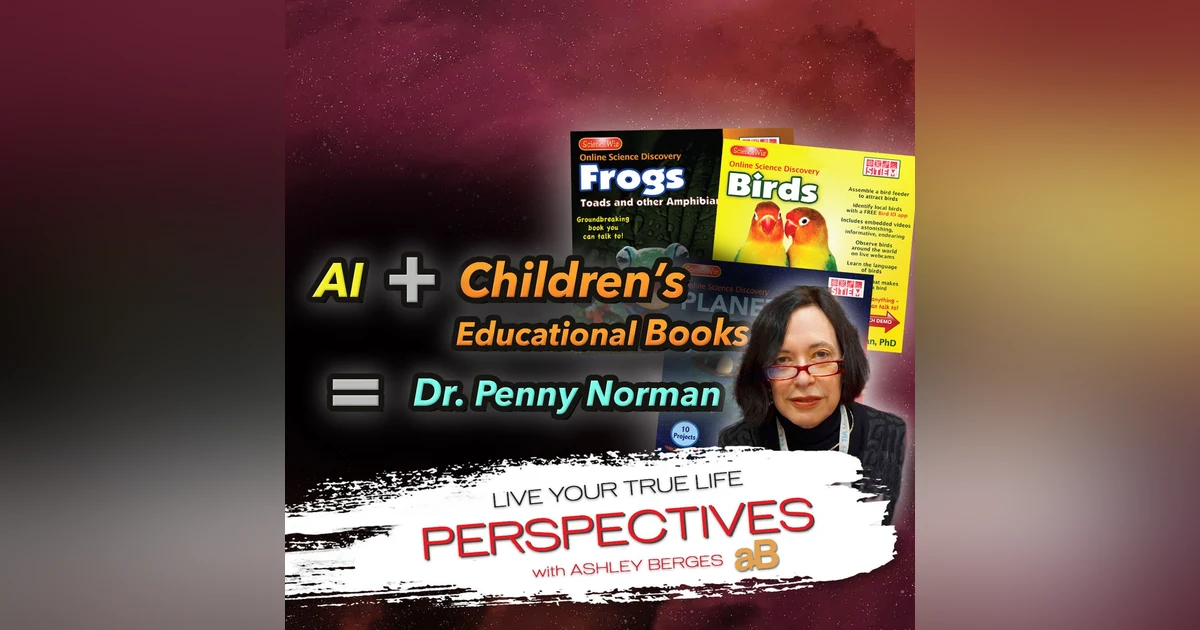

Today’s show will discuss science and keeping our children up to date on the most innovative ways to obtain accurate information for them to learn. Joining me is Dr Penny Norman. Dr. Norman has a Ph.D. in Biophysics from UC Berkeley. Dr. Penny is...


 RSS Feed
Today’s show will discuss science and keeping our children up to date on the most innovative ways to obtain accurate information for them to learn. Joining me is Dr Penny Norman. Dr. Norman has a Ph.D. in Biophysics from UC Berkeley. Dr. Penny is dedicated not only to children but also to education. She has written more than 20 Science STEM books for elementary-aged children over the last 20 years. A number of these STEM books have sold millions of copies. These titles are based on years of work with children in the classroom and in after-school programs. She and her editor Ann Einstein have tested these materials and books over many years. Some projects work. Some do not. Some engage children. Others do not. It is only through years of “watching their faces” that activities have been sourced and selected.
Her books and kits have received numerous awards, including Family Choice Award 2018 – GOLD MEDAL, Multiple Creative Child Magazine Awards, Scientific American’s Young Reader’s Book Awards, Good Morning American’s Top Ten Children’s Toys, multiple National Parenting Magazine Awards, The Parent’s Choice Seal of Approval, PUZZLE of the YEAR from Games Magazine, and a Modern Library Award. See ScienceWiz.com for an almost complete list of her titles.
Become a supporter of this podcast: https://www.spreaker.com/podcast/the-ashley-berges-show--1272964/support.
0:06 You're in a good place now. You are listening to Perspectives with Ashley Burgess. Welcome back Live to Ligerature Life Perspectives and I'm your host, Ashley Burgess on today. So we're gonna be talking about science. We're gonna be talking about planets, birds, mammals, frogs, and a lot more things because it's about education and it's about keeping up with the education of our kids, and we're trying to get to that point where they can have unlimited amount of learning, unlimited knowledge base, and the most up to date knowledge and information because I think that sometimes there's a limitation on that some of the school systems, maybe there's a limitation in what they're able to teach and being able to have children be able to ask the questions, be able to learn the information, the current information, and be able to really think about that and concentrate on that and let that develop not only their minds but also their bodies.
1:07 So joining me on today's Live Your True Life Perspective is doctor Penny Norman. Doctor Penny Norman has an amazing biography. She's done a lot of things, let's put it that way. She has a PhD in biophysics from Berkeley. She's also had her postdoc offers from Oxford and also Cold Spring Harbor. She's a humanist background in science and mathematics. And you know, her background is so amazing because she's done so many different things. She has a master's in so many different information as far as mathematics, you know, working with NASA, all kinds of things. She's going to talk about that when she comes on. But the biggest thing that I find that's so amazing about doctor Penny is her dedication to children, but her dedication to the concept of education.
1:51 And we all know that children are our future. And the more educated and the more understanding that they can get, you know, the better we are and the better they are. Doctor Penny. Great to have you on Live your true life perspectives. How are you doing. I'm here and thank you for having me. Ashley. I'm so glad you're on the show. And let's first off, let's start off. You know you are you founded a company which is which is now known as Science Whiz, and you've written more than twenty science stem books for elementary age children over the age over the last twenty years. And some of these stem books have sold millions of copies, which is amazing, and I'm actually holding on to some really amazing stuff right here, some stem books, but also these books are also they can talk to you. So tell me more about, first off, how you kind of got into this realm, and then we'll talk more about your dedication to education in the future. Here, well, how I ended up. It's a woman's path. You know. We start and maybe everybody we started in one career path and life and serendipity takes over and you end up where you end up. And so I suppose that, and I had children, and in having children, I became very concerned about what was and wasn't being taught, especially about that time in elementary school in the sciences, because it hadn't improved since I was there. In fact, I think in many ways they were teaching less rather than more. And so that's how this all began.
3:25 And I'm sure that's true. Back in school. I mean, when you were growing up, the education was limited, right, I think even now the education of some degree is limited. But you know, when you were growing up, did you feel like there was a lot of things that you didn't get to learn, or you feel like was left out of the educational system. Oh yes, And I think, especially as I got older, I think one of the worst aspects of it for everybody, I think is if you don't learn the basic phenomenology of the sciences in elementary school. I'm not talking about just most of it's a tremendous amount of fun, but if you don't learn it early on when you hit junior high and especially high school, if you have no prior knowledge and then they throw you into a class where they expect you to do that, learn the phenomenology and apply the math.
4:18 I think it's it's like, you know, throwing people all into the deep end of the pool and expecting all of them to swim, and it doesn't work. And that I think that's the root of the problem for science education in the United States, is that we cover very very little science content in elementary school in a way that's really just playing fun but also primes you to succeed later in those fields and just give you a general framework of knowledge to understand the world you live in. That's so true and a lot of times too. And you and I had talked about this prior that it seems like a lot of the educational system right now is based on testing. Right it's about passing certain tests and then kind of teaching to the test is what I've experienced. Actually, what do you think about that? I think it's awful. Yeah, no, I think that you know, the best best school internationally Finland doesn't do any of that, and I think it's diminished our schools. I mean, it's made a lot of money for the testing companies, in the range of billions in some of the bigger states, but I think it's achieved very little. And I think now with AI, the need to make it separate from the learning process itself is essentially going away. I agree with you, and it's interesting too. You're right, it's about the testing, it's about those companies that are making money. And then what,
5:49 you know, what are these kids really learning? And then how deep are they really being able to get into things that really matter? Well, I think that's a very good question. I mean, for example, if you're going to learn to read, hopefully you can let you can read science as much as you can read about spot chasing. You know, you know, a story with little information content and have a great time doing it. I mean, my books are my original books were usually about doing projects and reading and following the images to do it. And I've had many children tell me, well, this is my kind of book, So you know, there are many kinds of reading and this we don't have to restrict it to topics without information. That's so true, and it's interesting. I got, you know, some of the books in obviously, and what it's really interesting.
6:44 One of them is the online Science Discovery of Planets and the greatest thing about it is it has it's a hands on project as well. And then there's a plan planet Finder app which is very interesting. Tell us more to about kind of the hands on projects that you've implemented and put into all these books. Well, a lot of them are essential in this particular set, could be done with very you know, almost for free. So you know, we do include materia are not readily available. But let's talk about planets as of it. Actually, if you have a flashlight, a dark room around fruit and a stick, you can do it. And you don't. It would be silly to invest a lot of money when you can get a wonderful experiment. Going to understand all the cycles from the cycle the seasons to the day night cycle to you know, there's a you know, to the monthly cycle, to the phases of the moon. You don't have to invest money to do that. You just can do it. So why I you know, so I didn't want to charge for that. But there are actually ten very useful projects. And it turns out that most students they don't know why.
8:01 In the United States anyway, they go through their whole lives not understanding what causes the seasons. But a very simple experiment with an orange and a flashlight in a dark room explains it. That's amazing. It is interesting the things that are left out, and I think that's a that's a good point about what you're making or the things that are left out and some of the things that you know, some are maybe simple, but also some things that could be easily learned by activity instead of you know, thinking about the testing type situation. The other thing that I like about this too is the book You can actually talk to you So let's talk about that a little bit.
8:43 Well, we link to an AI bot that it's a three D uh semi three D animated character that you talk to and you literally can speak to it or you can text to it. Whichever you prefer so, and I think it's a very natural way to read about science because as you read along, but most of us have questions. Something isn't clear. We just have a question, and normally you can't ask a book that question and have it give you an answer, And now you can, and I think that it may lead to a different kind of reading that's especially appropriate for topics in science.
9:26 I think it's interesting too, the concept with the AI and being able to ask the questions because like if you take children in a classroom, kids in a classroom, I mean you have one teacher, and that one teacher is supposed to answer all these questions. I mean, do you see obviously these books being very interactive and helpful in the school, like during the school day in the classroom, I mean, how do you see that. I think it's transformative. I think especially in elementary school where teachers are often not well trained in the sciences, you know, didn't have much or any I mean any child that you can get to a question that no scientists can answer because we don't know. But that can make a teacher who isn't trained in the field feel very uncomfortable because they may not be sure of the answer, but they don't realize that no one. This will make the answers extremely accurate and at their fingertips. They can simply ask the just click on the icon, ask the bought for the question. She has a very nurturing voice. She and she'll answer it. Interesting. So, like if you're asking various questions about planets, and because again you're right, it's obviously AI is helpful because as humans we have limited knowledge sometimes so the knowledge base is a lot more vast. Obviously, I guess if you're asking AI, well, and it's interesting because you're really talking to a super polymath, and you know we are.
10:58 It's just really really interesting. You know, our encyclopedias can't keep up with this level of information that you know, certainly a printed Britannica, which is what I grew up with. We all had to have the Encyclopedia Britannica. I don't know if you were alive at that time. Every household had to have those in the fifties. Well, this is a superversion, but you're talking to an AI. It's actually just recently it's passed both the bar exam. I think the score was ninety seven and the medical certification exam, though its score was like sixty, but that's still passing, which is a little scary to me, you know. But anyway, you know, so you're talking to a super polymath. It's a really interesting transition we're going into because you'll have information, but it's all in a language structure that's geared to a nine eight, nine ten year old, So it's age appropriate in its structure, and is there a limitation on the things that they can ask well, in the sense that it structured to behave like a nurturing teacher who's schooled in science, but it's talking to a child that they think is nine to ten years eight to nine to ten years old, So it's not going to go off the rails and talk about drugs or violence or guns or I always use the phrase gun, sex and rock and roll. You're not going to
12:28 get answers for that out of her. That's hilarious. It's probably a good thing, and we were pushing it to try and test that, but we were afraid we were going to get excluded but from the app because we were just trying to make it to see if we had restricted it to the point that it was behaving well, and it was you know, it was very you know, it was working extremely well. And we then we used it at toy Fair where people were we're four days straight, we're coming in asking all kinds of questions because they all wanted to interact with it and see what she'd say. She never gives the exact same answer each time. It's not wrote, you know, and this it's you know, this is a generative AI, you know, So it's not you know, it's not that she'll tell jokes, but she's not very good at jokes, you know that.
13:18 So it's not not they're not bad, but they're not. They're not always I don't get all of her jokes. She will do a poetry actually quite well, and you know, so you can ask for a poem about climate change or some you know, you can ask her for the meaning of life, or you can ask her what is it what makes Pluto a dwarf planet? And are what are the most common birds in in your city or town? So you know, and she'll basically get it all right, So there you are. That's amazing. That's amazing. When we were turn doctor Pennie and I are going to be talking more about these amazing books and kind of the direction education wise, as well as more about her background and her passion for creating this and doing this for kids and for our future. So stay tuned Ligatrue Life Perspectives with your host me Ashley Burgess, will be back in I'll be back this time. Well, I'll be back this time in two shakes. Turn it up and jump in the deep end on Perspectives. Now here's Ashley. Welcome back live to Ligertrue Life Perspectives and I'm your host, Ashley Burgess. Joining me today in studio is doctor Penny Norman. She has an amazing background PhD in biophysics, you know, a humanist background. She's worked for NASA and the list goes on, and she's also created some amazing
14:50 books for kids to learn. And we were just talking earlier about one specific book, the Planets, and you know you were saying earlier about the Pale Blue Let's talk about that a little bit, doctor Penny. Well, when the satellite Voyager launched and I forgot I think was that the seventies it went, it made, it reached, it passed Pluto and they had it turn around and take a picture of planet Earth and Earth in that image is a single pixel wide and Carl Sagan, I believe, called it the pale blue Dot and we were just a pixel the whole planet suspended in a sunbeam.
15:33 That's what it looks like. And then he made a video a narration of that pale blue dot. It's one of the most profound commentaries ever made about Earth in the planet, and I don't think it should be missed. And it's there on that particular video or sound from YouTube is inserted into the book for listening to and seeing. It's quite profound. Another one right next to it is the History of the Earth in five and a half minutes, and that's a graphic novel and it's it's funny and amazing, but it's only, you know, under five minutes. It's just five minutes long history of the whole planet. And then one of my other favorites in the book is when we cover Mars, we link to this four K video of the actual surface of Mars, as developed from the images set back sent back by the rovers that have gone over on the actual surface of Mars. And that's amazing to really see the surface of another world and it looks a lot like Nevada, but it's interesting. So anyway, it's just it's packed with things like that, and it's just shouldn't be missed as well as the Planet Finders as well as this the avatar attached to AI, so you can ask questions as you
17:03 read along. And those are some interesting things that you know, you wouldn't catch in a regular science class, right, It's like things that they wouldn't probably bring up, or things that wouldn't get covered. Yeah, yeah, and largely probably not, you know, because they often just don't cover it, and they're profoundly interesting. One of my other favorites is the most studied asteroid ever that ever land on Earth, And there's a whole story about that because you know, it landed in nineteen sixty nine in Australia and broke up and the people around the community it scattered quite a bit, collected all these pieces and gave them to the government, and then a number of those pieces are actually at the University of Chicago. I'm not sure exactly how they got it from Australia, but they did, and those are and the stories about what they've discovered from that asteroid. It's actually older than the solar system and so it's amazing and the story of that asteroid is amazing. Well, we need to talk about it. When we return. Doctor Penny has a wealth of knowledge. We're gonna talk about more things as well that are very interesting.
18:22 I mean, she has written twenty science tembooks for elementary age children and this is amazing stuff. And her books and kids have received numerous awards, including a Family Choice Award in twenty eighteen and various awards as well. And so when we return, me talking more some more interesting stuff. Learning, I mean, I always love to learn. And on the side of the books everything says ages eight to eighty. So when we return, will be talking more with doctor Penny. Stay tuned, don't change the channel. We're gonna be talking about some more interesting things. We're also gonna deep dive into some mammals, frogs, and birds and talk about some other things as well. So stay tuned, look at your life Perspectives with your host me Ashley Birds will be back in well, we'll be back this time in two shakes.
19:14 This is Jake Busey and you're listening to Perspectives with Ashley Burges. Welcome back live to literature Life perspectives, and I'm your host, Ashley Burgess joining me in studio doctor Penny Norman, and she has a major background work for NASA. She has a PhD in biophysics, and the list goes on, but she's created some amazing books and it's under the name of Science Whiz, and so we have we were talking earlier about the planets and and let's jump in there. There's another that I think is very interesting, which is the Online Science Discovery of Frogs, Toads and Other Amphibians. And it's the groundbreaking book that you can talk to and so it combines hands on projects with online storytelling, three D manipulations, interactive explorations, so very neat. Let's talk a little bit about that, Doctor Pinny on the on the frogs concept here.
20:07 Okay, well again this one. There are no frog idea apps in the United States, so that was not included. We have that with the bird Idea app and the planet Finder app for the book on planets, but there actually is an amphibian Idea app in Australia. It's kind of interesting there because they're they're almost like the canary in the coal mine. Frogs and amphibians in general then because they're sensitive to environmental changes and they're living fossils. But again it I think this is the youngest of the titles, and it's it's a hoot. It's just charming and fun. I love some of the songs in there. There's one from the National Academy of Sciences out here in California.
21:00 They did a frog sound which song which is delightful on frog on amphibians and anyways that it. But again this is in multi modal. So one of the most important things to know about amphibians is they are the vertebrates that colonized the land and they did this in the carboniferous, so that it and but before we reach that point in the book, we also obviously talk about metamorphosis, which they do with they make a spinner and it's fun and they color it, and you know that goes through the stages of metamorphosis. And of course frogs makes it sounds and if you only have a book, you can't hear the sounds that the frog makes. And as it turns out, the bigger frogs make very deep sounds, loud sounds, and the smaller frogs tend to be more high pitched and you can talk about that in a book, but if you have a you know, a thirty second video with the actual recording and watching the frog make the sound, then it's a picture's worth a thousand words. It really gets it across and it's just plain fun.
22:12 And you know, so that's kind of what this book is, this merger of modalities. And then you know, it goes through metamorphosis, and they draw the pictures of metamorphosis. But you know, but there's nothing like actually watching a time lapse video of the stages of metamorphosis. So we link to a video on YouTube that it has had what almost ten million hits now where children watch a time lapse of the metamorphosis of a frog and it's quite amazing to watch. That's why it's had all those hits. And that's what we're doing. We're grading across all these modalities. So it's a charming title with songs and videos and sound elms and you know, and the biggest frog, you know, the goliath frog is in there, and the tiniest frog and it's smaller than the width of the radius of a dime. It's tiny, and and it was you know, so there's just but there are also exotic frogs and poisoned dart frogs and it's always fun. And gee whiz, there's even a frog that's freezes over the winter and that's the fabulous story. It literally is almost legally dead by almost any definition, except that in the spring it comes out of its frozen state and immediately goes off to find the meat.
23:41 That's it. That's what this frog does. So it's a very interesting. I mean, it's hard to believe, but there are animals that have go through cryogenic freezing and succeed and come out of it and go on to continue their lives. Oh that's really interesting. I mean. And then there's this fabulous story about a pebble frog that climbs and climbs and climbs. It's somewhere in South America, and but its biggest enemy is the tarantula. And when it encounters it, it doesn't fight back. It just throws itself off this mountain cliff or down and rolls tompun just stumble. It just rolls down the off the cliff, but it isn't harmed, and then it starts climbing again. That's its defense. So they call it a pebble frog. It's like a pebble that can fall down and unfortunately doesn't have a way to fly up. Oh my goodness, really interesting things. And you know, and then again what's also extremely interesting is that frogs really are not just frag Amphibians were the first vertebrates to walk on land. Before that, you know that the land was barren and there were no animals on it except for the creepy crawley strage where we had scorpions, millipedes and then spiders and aracmids, but we didn't have any vertebrates, no birds, until the no reptiles. Nothing
25:17 was on land. And except the creepy crawleys and then the amphibians that go through metamorphosis and could breathe air, were able to walk on land, and they colonized the land for animals for the rest of us, for vertebrates, animals with a backbone, fish, birds, reptiles, amphibians and mammals. That's us. Wow, that's amazing. It's a wonderful story. And you know, and and it's you know, it's so before the dinosaurs, before the age of mammals, which is what we're in, there was the age of amphibians, giant amphibians. Well, that's amazing. Yeah, those things that you don't really you don't learn. Those are things that you don't learn about things. You know what I'm saying. They've left it out. We get coverage of the dinosaurs, they've had a lot of press, but we don't get many we haven't and we don't learn about the giant amphibians. And we actually don't learn about the terror birds, which is a wonderful story in and of itself. So which is another when you get into birds. There really was. They were the apex predators in South America. They're covered in the you know, in the book on birds, and they were ferocious.
26:38 Wow. But and they were actually alive when humans were alive. And but the humans that were off in uh Africa and the terror birds were in South America, which at that time was an island continent separate from North America. But when the when the Isthmus of Panama formed and that land bridge formed and it shut off the Pacific from the Atlantic at near the equator. When that happened, the terror bird there was this great migration and the birds, the animals that lived in South America migrated North and vice versa. But the really wild thing is most of the animals living in South America or died off for various reasons. So most of the unique critters that are now in South America were from North America. Oh wow, they're invasive species. That's amazing.
27:41 So it's a wonderful story. But that's what. So the terror birds made it, they know, to Texas and to Florida, so they've only found this certain number of fossils, but then they died out, likely because of wolves and the sabertooth tiger were just too much for them. And probably and the cold because when the isthmus of Panama fused, you know, when that formed, that triggered what are the pattern we have now, which are these periods of ice ages and interspersed with interglacial warm you know, the warm periods. We're in one of the warm periods now, and that that was triggered by the formation of that land bridge. Up until then, the earth was warmer, but the circulated patterns in the ocean were different because the Pacific was directly connected to the Atlantic right at near the equator where Panama is now.
28:44 That's interesting, it's a real interesting story. So that's so, and but that may be part of the reason why terror birds died out because suddenly we had, especially in the northern hemisphere, we had these ice ages and it probably couldn't tolerate that cold. So you know, there are series, so there were a number of reasons why they probably didn't last that long. And you probably wouldn't want to meet one because they were, like I don't know if they were ten feet tall. They were tall, and they were ferocious, and you wouldn't want to have to deal with one. Definitely want to bring one in as a pet right now. They truly were the apex predator. They killed practically anything else they wanted to. They were huge. Wow, that is amazing, and it's amazing to learn that kind of stuff, you know, And I think it's even as even the adults that are listening to the show, you know, we're all, you know, listening to this entire concept. This is this is interesting, it's profound, and I think it also gives more of an understanding of, you know, where we came from and our universe and our planet. And I think that that also makes things more meaningful. I think, yeah, I think it gives you a framework of knowledge that that informs your worldview, and it's so often left out, and there's no reason to leave it out in terms of the it's just interesting to almost any age. It's just plain interesting stuff. Yeah,
30:15 exactly. It's the things that you want to learn. It's it's those interesting topics. It's those things that you know just I don't know, they give value to where you are, where we've come from, the evolution. And also I feel like it makes you more mindful, you know, in the process, because I think sometimes we're kind of walking through things we we we tend to learn maybe a limited amount or as much as we have to to get by. And that's another thing that I find as a problem in our society today is that you know, growing up and going through the school system, I did the same thing. It's like, you know, you did what you had to do to pass the test, and then after that it was you know, you didn't really pursue it. You didn't you didn't really get or dig deep into something. And I think that the greatest thing about these books is like for example, with the Birds, you know, it's obviously very interesting. Another sidebar of it is you know, being able to Identify is like an app to identify like birds by not only by the way they look, but the sound, by how they sing a song, you know. I mean that's pretty cool. I mean that's not something you think about every day. Well yeah, and that's a major resource and that's available for free and from Cornell. It's a fabulous and we link to that and show you and it you know, it works, and you can use it to identify birds in your local neighborhood. But you can also use it to identify birds that you see on webcams all over the world, and we actually link to a number of those. And I mean it's really interesting that the
31:45 birds in South America and South Africa, I mean, they're so beautiful and colorful, but you can use the app to identify it, you know, Like in the US, we have what three or four hummingbirds she's that live in various parts of the country, usually only one or two in a given region. In Ecuador, I think they have over one hundred species, and the coloration on them is just amazing. They're just so beautiful. That is amazing. It's it's and then the other thing that I find interesting, so I'm also you know, I'm playing around with all these books and all this is great and all these activities. The Mammals series is also very interesting too, you know, and obviously that's you know, that's that's very interesting, the mammal series and all the information that that has, you know who, I like that discover Huey Toomb, you know, kind of the pecanory, kind of that situation, but also you know, creating that family tree of mammals, and I think that's really interesting as well. So we have stickers that go with that. But the other aspect is that and this is from my editor, An Einstein, and in her classes and she covered animals, she would end the class with a game of twenty questions. And the way she used that because you can't guess the animal unless you learn these categories, if you you know, And she used it for children to learn categorization.
33:15 So it's a lot of fun and you can do it. It's a game. So they were delighted to do it, and the goal was to guess the animals she was thinking of. But you can do that with AI and it reinforces what you're doing in the book. So I'm thinking she Electra thinks of an animal and you have to guess it with yes, no question. You asked the questions and she answers yes, no or maybe, and that's it. Oh wow, so very interactive. It's very interactive. And the other thing about it, I'm trying to remember that. I guess that's one of the most exciting features. I think is there's this reinforcement of what you're learning through a game. But it's reinforcing it. You know, if you really want to learn to add play on let's see right exactly exactly. I mean, when you're playing something, it definitely connects. That is so true.
34:06 Yeah, so that's that's part of what's in there. Yeah. And again, Oh, the other part I really like about that book. I guess they only have a few seconds here is the fact of as the dinosaurs died out, that the non avian dinosaurs. So, by the way, when you go bird watching, you're actually dinosaur watching. That's official. Those are dinosaurs, and when you start looking at them as a dinosaur, you see them differently. It's amazing because they are they are a lineage of dinosaurs birds. So anyway, the age of mammals began after the age of dinosaurs. And what's so there were mammals around during the dominance of dinosaurs, but they were living underground and nocturnal and tiny, but they survived the asteroid collision and the non avian dinosaurs did not. But then there was a missing, a missing link in our understanding of how those evol how the the how the mammals recovered and then radiated after the demise of the dinosaur. But that's been There was a young man in Colorado that has a you know, actually helped to find a huge number of fossils in these concretions that allowed us to have a much better knowledge of how that evolution took place. There's a wonderful story,
35:37 very interesting, Doctor Penny and I will be back here. Don't change the channel. We have lots more to talk about. We're also going to hear her golden nuggets of wisdom today. Just stay tuned, stay on the channel Live your True Life Perspectives with your host Measley Verdus will be back in I'll be back this time in two shakes. Get in here. You're listening to Perspectives with Ashley Burgess. Welcome back live to likaty Life Perspectives and I'm your host Ashley Burgess, Doctor Penny Norman and I have been talking today about all things science, mammals, frogs, planets, all kinds of interesting stuff.
36:22 No matter if you are an adult or a child, this stuff is very interesting, very fun. So, doctor Penny, this is the time when I ask all my guests to give me a couple of amazing nuggets of wisdom that you would like to share with our listeners. And so definitely I know that this is right up your alley. You could probably give us about one hundred, but a couple of them that you'd like to kind of discuss right now. All right. So, I think we're in a where we're in we're going into a period of uh where we have the potential to transform how we adicate our children that and it won't just be AI that will change this, I think as an example, during COVID, I worked on a my actual lifetime goal of mine, which is to take all this content I've created and I know is appealing and fun for children, or I wouldn't have been able to sell as many copies as I did, but anyway, and bring it into the elementary schools because if we change it there, we change it everywhere, and you know, I know, we have to overcome this issue of allocating so little time to teaching science in elementary school, and I think that's at the expense of our own ability to compete in the world and just to have a framework of knowledge. So what I want to convey in the process of doing that work and now adding in the AI, I think
37:53 what I just stumbled into realizing, which is very interesting, is that maybe a little scary is that using the tools we now have, we actually don't have a shortage of science teachers in elementary school. What we do have is a failure to use technology to solve the problem. And specifically, what I mean by that is, with the newer technology now at hand, one individual, one skilled, knowledgeable person in science can teach an entire district of elementary classrooms. It's because of the ability to use hybrid learning and aot to do it beautifully but with high production values. So it's going to be can be very very compelling and fun. And if it isn't fun, I think you've lost your audience and the potential for really teaching this. But it's not anecdotal, it's a framework of knowledge. I agree with that though, being able to use the technology is so important and being able to hone in on that doctor Penny, Where do we find you? Where do we find more information?
39:08 You know, a listener is very interested, you know, wanting to look at the books, but also kind of the background. Where should they go, Well, it's our website, science Whiz that science, and then w i Z dot com. Sciencewhiz dot com is where our products and descriptions of them are available. Amazing, Yeah, it's amazing talking with you. I mean, you have a wealth of knowledge, and it's so great because you're giddy about it too, which is so nice. It's like it's it's really refreshing, you know, and and I think that's what we want our kids to be too, is to is to feel happy and energetic and get any like giddy about the things that they're learning. It's not like force fed. It's like it's like being able to interact and experience it and have fun with it and enjoy themselves and learn things that they didn't know, and learn things that they their parents don't even know, you know what I mean.
39:59 You think about it, It's like a lot of us are have a limited a base of knowledge on a lot of this stuff because what we were taught in school was limited base of knowledge. We're learning less and less about less and less. It's kind of scary, exactly, less and less about it. I love it about less and less, and it's true and some of the things that we're dealing with are not the important things. And I think you're right. It's about creating that well rounded child, individual person really who can move forward in their life in all areas successfully and starting with the knowledge base that they get. And I think a lot of educational experts have forgotten this really really important point. If you don't love it and you don't find it interesting, you haven't been You're not going to be motivated to continue looking at it. And I think they're so concerned about this theory or that, and they lose sight of the most essential ingredient, which is this stuff is just playing fun and why take the fun out of it? Exactly exactly it is fun. And doctor Penny, I have enjoyed having you on the show and I look forward to having you back on a new show in the future if you're willing to come back on. Definitely learned a lot today. I love to thank you for having me. Just glad to have you, and I'm gonna have some fun with these books kits and be able to talk to because I love this kind of stuff. I mean, I think we're all, you know, learning and growing, and you know that's what life's about.
41:24 Is We're supposed to be learning and growing every day of our lives, no matter what our age is. Absolutely that's why they say eight to eighty. I love it. Yeah on the boxes, this says eight to eighty. Doctor Penny. Thank you so much for coming on. We appreciate you, looking forward to having you on the future and looking forward to your future endeavors that you have because I know that you have a lot more coming out. Thank you so much again for having me, Ashley, thank you doctor Penny was here. We had a great show. I hope that you can share this with your family and friends, because this is interesting, this is fun, This is education has changed in our future and all of us need to learn and grow and we can experience it and love it and be giddy in the same time. Say tuned literature life perspectives with your host me asked Burdens will be back in Well, I'll be back this time I'll be back this time. In three shakes,