The Cost of Being Always On | Shira Lazar #696
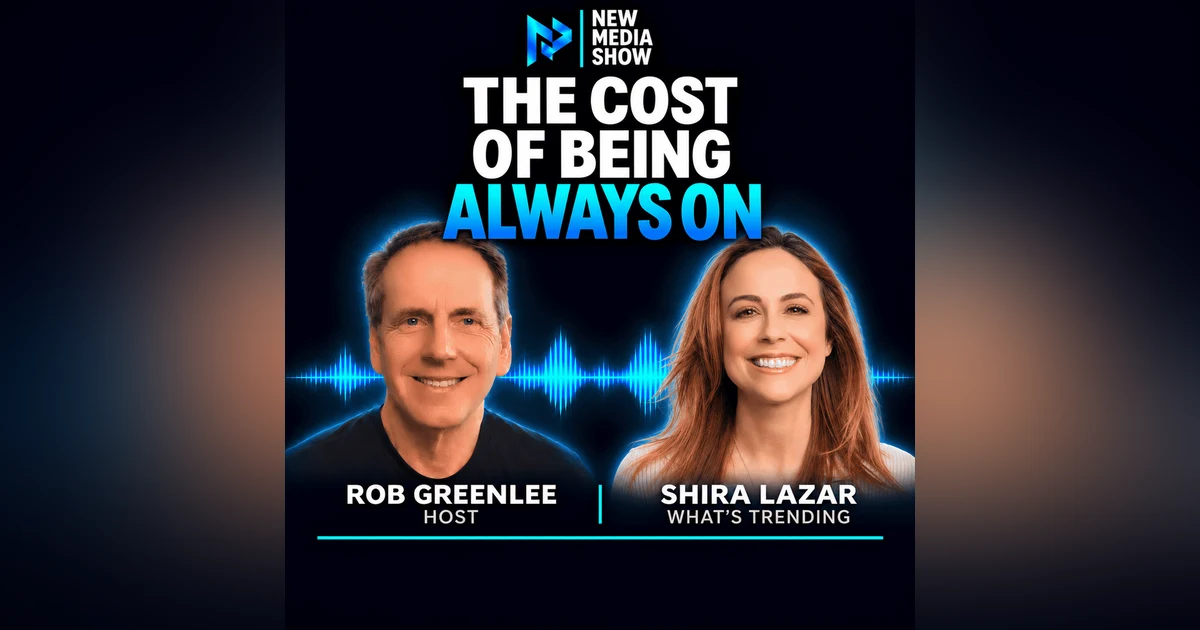

Creator burnout can make every new clip, platform, and analytics check feel like another obligation. In New Media Show #696, Rob Greenlee talks with Shira Lazar, founder of What’s Trending and Creators 4 Mental Health, about the cost of being always on and the choices behind a sustainable creator business.
Video episode
Audio episode
The conversation connects creator burnout with everyday business decisions: setting boundaries, accounting for unpaid work, choosing formats, building brand relationships, and using AI without giving up personal judgment.
Three editorial takeaways
- Set a boundary before the next commitment. Shira describes asking partners for enough time to make a decision and telling collaborators when she can respond. A busy season can be manageable; treating every request as urgent makes it harder to choose deliberately.
- Count the work behind the deliverable. Track unpaid preparation, publishing, outreach, and promotion when evaluating a brand deal. The visible video is only part of the work that makes the partnership possible.
- Choose a publishing model you can sustain. Start with your audience, your goal, and your available capacity. Long-form episodes and short clips can support each other, but clip viewers do not automatically become full-episode listeners.
One practical action: For the next seven days, keep a simple log of unpaid creator work and how often you check analytics. At the end of the week, choose one boundary to test: a set analytics review window, a clearer response deadline, or a limit on one optional task. This is an editorial exercise inspired by the conversation, not a promise of better health or audience growth.
Creator burnout and boundaries in a busy media business
Shira approaches her own workload as a work in progress. She discusses accepting the demands of a busy season while noticing when pressure becomes persistent and starts affecting daily life and relationships. Her examples include decision fatigue, competing deadlines, and the need to communicate a realistic response time rather than assuming other people know her limits.
The practical tension runs through the episode: creators need to show up consistently, yet their capacity is finite. Shira does not offer one schedule or format that fits everyone. She encourages creators to choose what works for their goals and circumstances.
Revenue, production costs, and longer partnerships
Looking back at What’s Trending, Shira describes the resources required for a daily live studio production and the challenge of sustaining it. Brand sponsorships, platform revenue, and ongoing business development played different roles; audience visibility alone did not remove the need to build a workable business model.
She discusses partnerships that can span a series, social content, events, or an ambassador relationship. Additional appearances and work beyond the agreed integrations need their own negotiation. Her interest in longer relationships is a business perspective, not a guarantee that a particular creator will secure those deals.
Long-form, clips, and deeper audience relationships
Rob and Shira explore audio, video, live production, and short-form discovery. Shira sees room for these formats to coexist, while cautioning that a large short-form audience may never watch the longer show. The useful question is which combination serves the community and can be produced efficiently.
She also describes growing interest in expertise, engagement, and in-person relationships beyond follower totals. A focused creator’s value to a partner can depend on the community they reach and the relationship they have with it.
AI as support, with room for independent thinking
Shira shares how she uses AI as a thought partner for organizing ideas, writing, editing, pitches, and preparing for negotiations. She also describes beginning to use it to flag email priorities. These are examples from her workflow, rather than measured claims about time saved.
She acknowledges concerns about AI’s impact on work and argues for curiosity and informed choices. Her caution is to keep exercising the judgment and perspective that make a creator’s work distinctive, including making space to brainstorm independently.
Unpaid work, analytics, and creator burnout
Near the close, Shira discusses the Creators 4 Mental Health study and associations she reports between wellbeing, frequent analytics checking, unpaid work, and everyday support habits. These are her account of research findings, not evidence that a single habit causes or resolves burnout. The linked study overview provides context; the full report is needed to evaluate the methods and detailed findings.
Questions answered in this episode
What does Shira Lazar recommend for managing creator burnout?
Shira emphasizes setting realistic response and decision boundaries, noticing when pressure becomes persistent, and choosing a publishing routine that fits your capacity. She describes this as an ongoing practice; she does not prescribe one schedule for every creator.
How can creators account for unpaid work?
Track preparation, outreach, publishing, and promotion alongside paid deliverables. Shira argues that a brand deal should be considered in the context of the work it takes to build and sustain the creator business, rather than only the hours spent on the finished video.
Do short clips automatically create long-form podcast listeners?
No. Shira explains that short-form and long-form content can support each other, while many clip viewers may never watch or listen to the full episode. Choose formats around your audience and goals, and assess each format separately.
How does Shira Lazar use AI in her creator workflow?
She describes using AI to organize ideas, co-write and edit, prepare pitches, and think through negotiations. She also discusses email prioritization and the value of brainstorming independently so that her own perspective remains part of the work.
Who is Shira Lazar?
Shira Lazar is the founder of What’s Trending and Creators 4 Mental Health, and host of The AI Download. She joins New Media Show host Rob Greenlee in episode #696 to discuss creator burnout and a more sustainable approach to publishing.
Guest and research resources
- Shira Lazar’s official biography
- What’s Trending
- Creators 4 Mental Health
- Creator Mental Health Study 2025 overview, conducted with Lupiani Insights & Strategies
- Shira’s October 5, 2026 announcement of The Check-In with The JED Foundation, referenced in Rob’s opening question
- The AI Download podcast
Related New Media Show episode
For the discovery side of a sustainable publishing strategy, explore episode #695 with Headliner’s Neil Mody on podcast discovery, social clips, and the path to the full show.
Build an audience. Earn trust. Grow a media business.
Production disclosure: The opening announcer voice is AI-generated. Rob Greenlee hosts the interview.
The post The Cost of Being Always On | Shira Lazar #696 first appeared on New Media Show.
0:00 Well, welcome to the New Media Show. This is episode 696, and there's always a video clip to cut if you're a creator, and another platform to feed with your content, and another number or stat that you have to check. So if you have half the time, what would you Let's get into it Welcome to the New Media Show with human host and podcast Hall of Famer Rob Greenlee Well, I'm, uh, Rob Greenlee, and the website for The New Media Show is at newmediashow.com.
0:48 And today I'm joined by Shira Lazar, who's the founder and longtime CEO and, and host, actually, of the long-running, uh, whatstrending.com platform, and is a more recent founder of a platform called Creator for Mental Health. And so today we're gonna talk about creator burnout, which I think, uh, if, if you've been involved in creating media for a long time, you can definitely associate with, and how to build a publishing r- routine that you can really realistically I think it's one of the biggest issues a content creator right now, 'cause all these platforms and all these different formats and all sorts of stuff.
1:29 And at the end of the episode, we'll hopefully have one kind of boundary that you can set f- for yourself, in that path without sacrificing the path to success. But Shira, welcome to The New Media Show." It's great to have you on the show. Yeah. Thank you for having me and covering this important topic for everyone. Oh, I think it is an important topic, and if you've been a creator for many years, I, I I think you can 100% relate. But you, um, posted a, a, article in your newsletter, The Check In, and it⦠And you ask, uh, you know, about this topic of, of keeping showing up to your, you know, your audience and your communities and things like that, while also taking care of yourself as a creator.
2:16 And, and I think it's really, um, easy to fall into the trap of taking on too much. And, and as you get more popular and as you get, uh, more successful, demands actually increase. Um, and I think, Shira, you're a classic example of this. You've been doing your, your What's Trending platform for a very long time. I, know, I, I remember- Yeah ⦠pull- pulling up into gas stations and seeing you on the, the video screen pumping gas for, for r- for many years. So I know y- you've been playing at the edges of But, um, us a little, probably at a deeper level, what, what you've been through, and how you've coped also.
3:02 I know y- you know, you're dealing with deadlines today and- ⦠and I'm, I'm dealing with deadlines today too. We all have something. And so- We all have something you cope with this? great to have you here. Thank you. Yeah, thank you. No, every day is different. I have some days, that I cope with it better than other days, and that's I think that realizing you're human and having compa- compassion and grace for yourself is really important. I mean, again, I'm always living and breathing this in a work in progress. Like, there's been many times because of the work I do, something will happen, a friend or a colleague or an employee will be like, "You talk about this stuff, and then look at you." I'm like, "Yeah, I never said I was like a guru or Yoda or like⦠I'm human.
3:46 I'm still learning. I'm figuring it out just like everyone, so me grace." That's not necessarily an excuse- Right ⦠to do crappy things to yourself or others, but it's this idea that we are hopefully all trying our best, and every moment, if you go off the path, is a moment to have that realization, accept where you're at, and kind of use that as information to get back on a path Mm-hmm more aligned, right? And I think life is a constant, a movement between both those spaces, right? It's kind of like the act of meditation. In meditation, you could have a point of focus a phrase you're coming back to, and your brain as a human will naturally default thinking, distractions, and that's part of the meditation process, right?
4:40 It's this idea of being ⦠having an awareness of where your brain is going and then coming back to the point of focus, and I think of day-to-day life like that, too. I also think there's many right? You could be in a busy season that you get to show up, right? You might be a new kids might be, you know, in a certain time of life, going to school now. Like, you might have just started a new job. You might have a big project, a big deadline, and I think it's accepting that- This is where you're at and how you, need to show up and, and deciding how you want to show up, and that it might like that, that period of time.
5:24 And I- for me, I believe that's okay. I mean, again, if, if that doesn't align with you, that's not how you work, do you, right? You need to know who For me, that acceptance creates a lot of peace and allows me to kind of just enjoy sometimes the chaos that is life, right? And, like that's just part of it. But being a creator can be a little exciting too, right? And then realizing like there's a point that that ends maybe, that project, and I get to use that as a goalpost to then step back and hibernate a little bit. Again, like the seasons, right? You have your winter, you have your time of hibernation. You have your summer, Mm-hmm. you're out there partying. Like, I look at, um, the way we work and how we live and exist as humans in a similar way, just like we are an animal, right?
6:10 And I think, again, the more we accept that, the better the experience can be. However, I do think when we talk about burnout or anything that's more long-term and when it gets chronic, where it starts to impact your day-to-day life, um, how you act towards yourself and the people around you, and when that leads to unhealthy behavior, that's when it's important to look at how you're living and those things that are impacting you and saying, like, "Maybe, yes, I do need to step back," or, or maybe choose a completely different direction. And so, again, I, I um, all of this a balancing the doing, the action, and then the awareness and realigning So how important are kind of creating kind of, kind of like mental boundaries- of, things that you do and, things that you don't do?
7:07 And I know, you know, even, even doing a recording like this in the face of you having pressures with the Clio Awards and things like that that are going on tonight in your life. And I have no outfit yet. Right, okay. I threw out all my outfits. They didn't fit my body. Yeah. You know? Yeah. As a woman, there's like other pressures that I think we talk about. I mean- Yeah ⦠women know. Yeah. but that bec- creates an extra level of pressure. I mean, I'm not gonna say it's a gender thing, but for, for everyone, but, it does feel like there's that extra pressure of, like, your face. can't look too tired, the wrinkles, like, the hair. It's just, like, all those And I chose this life.
7:48 I'm proud to be a woman and to take care of myself. Yeah. I love it. And, but when it's working, it's working, and when it's not⦠Like, if, if you don't have your hair and makeup ready, or if you don't have your dress, like, these are additional things that I personally think about. And yes, it, it, that could create a lot of, a- anxiety, Um, I try to- Yeah, of course, right ⦠you know, I try to confront the anxiety and then kind of look at the ridiculousness of the situation be like- ⦠"Here we are." Kind of, I try to have some humor in it all, um, because that's all I can really have. And then again, it's information, like, "Okay, maybe next time we're gonna do this differently," right? Although I have so many events, and I plan it, and there's just sometimes things slip through the cracks and it just doesn't happen.
8:32 But, um, and then I also have a script that I need to prepare for a trip tomorrow, Yeah. and I might need to change my flight still. And the idea is that when you get to a certain point, maybe you have a chief of staff or some assistance and support. But I do know that in the end- Or you have an AI agent that does that does some of it for you. Yeah, like, and I think that's where AI, like a lot of people are looking at AI, AI agents- Yeah as a good thing because I think that if, if you are in a place where you're a, solopreneur, you run a small business, there's a lot of expectations for you to be doing a lot and you can't keep up, this is where AI agents can really support you, and I think that's, like, a really good thing. That said, I think we're each still accountable for our own life.
9:13 So as much as I have support around me, uh, and I would love many times other people to be making decisions instead of me, 'cause I do get decision fatigue, which is a symptom of burnout. Yeah. I realize that in the end, is my life, this is what I'm creating. I have amazing support around me, but no one's really gonna care as much about it as me, possibly. And not about the creator's Mental Health stuff and⦠But, you know, sometimes the what's trending thing. Like, in the end, we're all living our lives. Well, everyone has a lot going on, and I⦠And there is that awareness, right? Yeah. As I exist in this But then it's about, you know, when it comes to decisions, stepping back and giving yourself again to Um, and sometimes even go out of⦠You know, I have a decision to make right now around certain deals and partnerships and models that I need to figure out around that, and it's overwhelming me, right?
10:09 Mm-hmm. I⦠In my head, I'm spinning, I'm, like, calculating all the and I would like to slow down and have some time with it, and, uh, my partners might not give me the time. So it's about me, and then you talk about boundaries, setting the boundaries, saying, "I need more time. I'm not in a place to make a decision." Unless, again, you're under deadline. I get it happens. But, like, that you need the space to make decisions that you feel comfortable with in order to better exist in the relationship. As a partner, they should respect that. Why would they want you to be doing work and, and showing up in, in relation to them in a bad way, right? So like this is where the mutual respect comes in, and setting that boundary for yourself, 'cause no one else is gonna set it for you.
10:53 Like, that's also lot of people expect, like, "They should know this. they should k-â¦" Like, we all work differently. We're all in our own life. We're all in our own you get to set that standard for yourself and others, and it's up to them on how they're So, you know, for me, like something like this is actually the most chill part of my day. I try to stay as present as possible, knowing that probably, and take off that I'm probably getting pinged and ponged, and Yeah people are waiting on some things, and I kinda know coming out of this I'm gonna have to kind of get shot out of a cannon and just handle stuff. but again, in the end, I've s- I will survive another day. I've gone, gone through worse.
11:35 I'm here still. And, and you really need to tell yourself that. It really is mind over matter sometimes, and the self-talk saying, "You're safe, you're gonna be okay." And then now, what is, what actions do you need to take? 'Cause a lot of times when you're overwhelmed, you might have a busy day, you're like thinking about everything. Oh, and then there's more things coming and then it's a spiral, right? And in those moments- Taking a deep breath, 'cause a lot of times we're not even doing that, and then saying, "Okay," like, "What is the immediate thing I need to do right now?" And just getting that one thing done and then moving on to the next. Like, simple steps, right? And then as people are hitting you up and calling you and saying, "I, I n- I thi- I get, I need to put this aside right now.
12:21 I can't get to it until X day or X hour right now because of other Thanks for letting me know." Like, a lot of times people won't answer, but like, I mean, I try to answer people just to let them know a by when, including if they are relying on me. So, or, or yes, there's sometimes don't answer those people if it's not a priority right now. So again, that typically works in those moments, as well as some and gratitude. Gratitude for u- for it all. You, like, living- Yeah ⦠life. Like, this is life- Yeah ⦠living, life maxing basically. Well, you're living an exciting life too, and I think that's the other piece of this, that it comes with stress and it comes with and it comes with opportunities and it, and- Yeah.
13:10 you know, so it's- Yeah, exactly. Yeah. And I, I'm embracing it all. And again, I, I have had moments and days in my career where I was so busy and successful, and then many periods where I was begging for work. Which was me. And so for me, when I'm having a moment and there's a flow, yeah, you wanna take advantage of it, and also have gratitude for it, of like saying, "Well, I asked for this, and this is why I do what I So again, it's that balance of enjoying it, showing up for the work in the best way possible, but also- You know, it needs to be intentional, but not taking yourself too seriously.
13:53 cause I know when I do that, then a lot of pressure comes back, and then before you know it, you're not enjoying the thing you asked for, right? And like, Yeah â¦so that could be a bit of a mind z- f, as they say, where you're like, "Oh my God, it's all this amazing stuff, but now I'm like too anxious to even enjoy it." And then what's the point? Yeah, and part of it is that there's ebbs and flows that go on, um- Yeah ⦠on this journey. I mean, know you- you've been creating online content for probably almost as long as I have, and, but you've been doing it down in Hollywood and in that type of environment, which h- has a lot of pressures around it too, and you've gotten some terrific d- d- you know, distribution opportunities on, on a lot of platforms that give you a lotta, lotta, lot of visibility.
14:41 But yet, at the same time, things ebb and flow, right? Things don't always, uh, maintain. You know, I know in the early years when I was following your, your career with the What's, What's Trending, you, you were doing a lotta, a lot of, video podcasting back in that time. Yeah, let's, uh, move on and talk about another topic. You know, the, the ebbs and flows of being a content creator from the standpoint of, you know, sponsors, monetization, and how have you handled that over the years? 'Cause if you're been a creator long enough, you, you have gone through these ups and downs. And, and have you seen big kinda shifts and changes o- on that? I know you started very early, um, w- with your What's Trending platform as kinda like a video podcasting platform in the early years.
15:26 that was back when I was working for Microsoft and Zune. I think I and, met with your team in your studio in LA- Oh, my God. Wild ⦠and things like that long, long, long time ago, back when I was working for Microsoft so, you know, that was a very different era Um, in some ways, you know, it's almost like a back to the future kind of a moment. Back in that era, video podcasting pretty, big. And, and then we went to- It was like live streaming. I mean, we were live streaming at the time. Now it's in a back to then. It was like a talk show, which is, again, I feel like now we're kind of back to that. Like, so many people are building like there's TVTN, there's, um, the, uh, they're kind of like Hollywood Instagram or whatever.
16:10 They started live, like literally versions of like what What's Trending did and started with. And then in a way, I kind of wanna like do that again. it is a lot, I mean, it's a lot of work. It's a lot of res- you know, you get a lot for what you put in. But being live daily in that way, I mean, Young Turks do it, it's a whole other ballgame, right? and process and workflow. Um, and then again, I- most people, I would say, like, like Hasan Piker is obviously but most people when they're going live aren't getting as many people as like the social on demands. I mean, TVTN is one, an example Yeah. And so you're putting in all of these resources for live, and then again, it's like what's worthwhile in terms of the And I think that a lot of you are, like, really into it now, and obviously live streaming is big, but it's like there's the rogue live streaming where you're like, you have your c- you're in your own space, in your a- home office or like your laptop or your phone, and some of these are like pretty big setups So, I think it'll be interesting to see if those financial models can be maintained that aren't like, again, going back to, rogue internet creator way of doing it.
17:22 if you're gonna be like, or you do one set up and then it's like auto⦠You know, everything's auto-rolling, right? Versus having crews and people there. I think there's ways to do it. It's interesting. At that time it just was like, it. got really expensive for us the way we were doing it, and the tech wasn't ready yet, right? we stopped down doing live. But, you know, our, Yeah, the bandwidth was expensive back then, too. The bandwidth to be able to- Yeah, like at the level, I mean, we had a jib and everything. Like Um, and we had, like, pretty big cameras. Like these were big studio cameras. Uh, maybe not like old-school rolling ones like that, but like it was, they were pretty, you know, Uh, and and to maintain that, the control room, the director, like, all of it was a lot.
18:04 Again, it's, it's different now. like you could have a d- director where you live or somewhere else, so, like, w- you know, the, the tools are different now. that said, the, h- the brand deals and how that worked in the past, yeah, everything came from What's Trending started because of a deal with T-Mobile. I'm like, is that, was that the brand? I'm pretty sure T-Mobile. was Um, it was T-Mobile. I mean, we had, uh, in the future we had ended up having like Samsung and other brands sponsor us. But we started the show with T-Mobile sponsorship, and we were doing it with CBS News. Then we basically went off on our own, got gap funding, and then we were just basically constantly building off of models.
18:52 I mean, we would make money on YouTube and other platforms, but that money was more fill-in money like not really enough fund a business consistently in that way. So it was kind of a lot of, like- Constant catch up, constant outreach, and in many ways it's still versions of that, you know. I think we're, you know, we're, trying to figure out ways to model out so we could see the year ahead and the revenue coming in. A- and, you know, even with the economy being the way it is and changing of the market constantly, I think there's still a way to figure that out, you know, including as we're doing more events and kind of understanding, like how much do we sell into these events, and if so, how much money we're making, and okay.
19:42 and then if you have, you know, you're growing on certain platforms, what that could look like, and if you're having, you know, longer term annual sponsorships. Like what I love about some of these shows, which, again, we've done, it's not like we haven't done it, but I think we went from the kind of seasonal digital show and programmatic working originally with CBS News to, like more the creator approach. and it felt, we did have longer term deals, but we really had to work towards those, and it could take a year or two to build those relationships. My hope is that in the creator space now, you know, they could look at what you do, see if it aligns And then you don't need to have a year or two of working together to get that, right?
20:23 You know, the idea is that in order to prove the model, you need to, work longer term, iterate, and then kind of see to your head, be less reactive, um, and that leads to, you know, being able to discount your rate as well. And I think that we're gonna see a lot more of that, whether it be brand programs or again, ambassador roles and companies coming in. Because they themselves, like they're⦠You know, we're all gonna be reactive, but we're all looking to look at the year ahead and work with people we trust that can execute, versus again, just trying things out and not necessarily getting what you want. Because there's a lot of new creators out there, a lot of new people that have not done this before. They might have huge followings, but doesn't mean maybe they're the best to work with, right?
21:05 and so a company still needs a re- reliability while having community and engagement um, someone that kills it, it's a constant balancing act. the theme here- figuring that out. Yeah. so how do you think it's changed, and w- where are we evolving to more? I mean, is it⦠You know, the online media space is becoming the, the market for media now. It's- Yeah ⦠these, these larger media brands are, are, increasingly struggling. but w- you see this, this evolving to? I know that the, you know, Apple is now, now supporting video podcasts, HLS streaming, all that stuff.
21:51 Do you see, um, podcasting being something that's kind of gonna fall to the wayside to some degree? And how do you see this blend between audio and video in, I in podcasting? I- i- as you look at kind of the modern- Yeah, I think it's about, like- ⦠uh, space ⦠media is media. It's like, where is it the best, what's the best way to tell that story, right? And I, I don't see- Mm-hmm ⦠long form going away. I mean, Instagram just announced they're long form. Yeah. And so- Yeah ⦠I, I do think it's about what the best format is for that, and then how you can build a model that makes sense and is efficient and Mm-hmm. Again, I think there's two kind of approaches.
22:32 There's the people that do super quality, like they show up, they do something amazing every so often, and then they peace I just don't think that works for a lot of people, 'cause most people need to be consistent and have discoverability, and, you know, brands need to continue to see those analytics and all that. Oh, was a spam call, so I think it's about figuring out, like, what is your niche, who is your community, where do they exist, and what's the best way to bring the information to them? And that might be, again, if you're doing, um, a long form video, knowing that you could possibly grow and build audio around that too, it's like how do you do that? And getting more bang for your buck out of the content you're creating.
23:14 So from the long form, what's the clipping strategy, et cetera. Um, that is gonna be really important right now. Like, I don't see podcasts going away. I just think you need to in how you look at launching and continuing a podcast, and I think it's more of like, "Oh, this is a series I do, and it happens to live on podcast platforms and YouTube," et cetera, all that. as a long form show, it's an audio experience, and, short form. And the short form, the reality is, like, most people might watch your short form and never watch or listen to the So, they coexist and support one another, but there needs to be also like, a little reality Because, like, if you're not a uh, creator yet, you know, a lot of people might just discover you and what you're doing from your short form, and it takes that consistency of being in their face, right?
24:12 To then, you know, one episode might hit, and they might say, "I really wanna check out that long form," and having that ready to go. But then, you know, if you didn't have the long form, you might go- not get all the short content. again, there's a way for them to coexist and help each other Yeah, it's a very- And by the way, money, like brands, because of where the market is, wanna spend money. Like even if you call it a long form series this, that, they wanna spend money on podcasts. They have budget set aside for that. so that's one that's good to know. But a lot of my work and my brand deals and money, more integrated marketing, so it's, are packages. Yeah. So it's saying that- you know, maybe you'll be integrated into the series in this way over 16 episodes, we'll do once a month a social video that is just around your product.
25:04 Um, you know, plus maybe it will include once a quarter an event, right? stuff like that, or a part of the contract that says, you know, that for events or any other appearances or additional brand deals around this brand beyond this, that needs to be negotiated, right? Beyond the integrations. Um, you know, again, there's ambassador deals where they just want you to use the product, get the word out, say you're an ambassador, be the go-to tool that you actually use, not just like talk about, but use, and that your whole team uses, and that they kind of exist with you and move with you in different spaces that you're in. So we're also kind of⦠We're in a trend where it's about presence offline- Mm-hmm ⦠and like that they're integrated into kind of your life.
25:53 Not just in terms of like your social or an ad, it's a very holistic partnership where, where again, you're supporting them, they're supporting you. know if my Um, they're supporting you, and it's not a one and done type thing, and then that Mm ⦠makes it more And build- You're building a relationship with the brand, they're building a relationship with you, You're sharing it with the community, so it feels like, oh, you're in⦠not to say in bed with each other, like friends and family Yeah. Two separate things, bed with each other and then friends you see the market shifting towards doing more, in, in, in person, uh, in real life- Yeah ⦠uh, type of experiences now, with online creators now.
26:39 Do, are you seeing that in Hollywood where there's a lot more push towards that? And are people really coming out for that? Yeah. Well, Hollywood's one thing, and then creator economy is a whole other thing. Yeah. It's two different things, isn't it? Right? Right, yeah. Um, no, I'm seeing that in the creator space because there's so much noise on social media, and like with AI slop and everything. Like they might have their, big kind of- uh, push in terms of, again, they're clipping social strategy. um, they'll do, you know, advise and, um, th- their social ambassadors, which who might be cr- big creators or people that, that, you know, you⦠No one knows but they do great UGC, right? That they could use as an asset.
27:19 So you see companies having that and then them doing more, deeper contracts and agreements with creators includes content but also just showing up with them at events and, you know- Mm-hmm ⦠again, where they can build relationships, go deep. We're, like, in a definitely- Yeah ⦠in this depth economy, right? It's not just attention and scale and going wide- That's a depth economy. That's a new- But going⦠What? Yeah, that's a new phrase, a depth economy. Um- Yeah, like deeper expertise- Yeah ⦠knowledge. You know, it's why the B2B creator is on the rise. You know, the affinity list I did with Evan Shapiro really explored this and showcased it in terms of the top 10 creators, not necessarily being MrBeast, but through this, equation we created, uh, through That included not just views and followers, but shares and comments and engagement.
28:14 It really showed the depth of people are following people and engaging with that right now. And, uh, the idea is the bigger you get, the MrBeast or the Drew Sky- Mm-hmm ⦠you actually become more like a traditional media company in a studio now, and that relationship with your audience isn't, like, the same as it is for maybe- Yeah more niche So, but which is an exciting, I think, opportunity for a lot of us where, uh, uh, you know, the idea of that, oh, well, and it still happens though, but the idea that you need to be X size to get paid X definitely is still there, Mm-hmm. but I do think it's shifting where I'm seeing a lot of creators that don't have huge, like, millions- Yeah but they have a very specific audience, they have a very specific expertise, and they'll get paid what maybe someone with a few hundred thousand followers would get paid because in their industry, they are known.
29:06 Like, Mm-hmm â¦it's a different type of and I think we're starting to figure out what, like how you quantify that? A level of influence that's not just, like, m- maybe on social and digital, but what does it mean in the community you're in? Like, when I say someone's name, well, they might get a lot⦠You know, do I know that person? Are they a thought leader? Are they actually influencing the community that they're in? And those people aren't taking, uh, or paying attention to what they're sharing. And then offline, when they, when they bring people together offline, do they curate that properly? Like, do people, again, pay attention and show up? And that's a different skill and a different type of influence. yeah I mean, it's it's getting back to the foundations, right, of human, human contact- Yeah ⦠engagement, all this stuff.
29:55 And it leads me to ask you about, you know, AI and how y- you're embracing AI, or how you're seeing the, the market embracing. I know that there's a lot of tension around AI right now. People are getting, you know, ganged up on because of their, their use of AI in their content. and, but I, I just wonder, and what your impression is, is that just a knee-jerk reaction to something that's, change? or is it something that is gonna g- gonna be a sustainable issue for content creators, that they have to cope with this, battle lines between using AI to help them versus having that backlash?
30:38 I, I, you know, I don't think it's necessarily an overreaction. This is a really⦠It's not new technology, but in this context it's new to a lot of people, right? Right. Exactly. And how it's influencing their work, it's all, that is a new, newer conversation. seeing the actual impact in front of their face, feeling it. You know, while the tech has been around for decades, like, the fact that someone experienced some, it it be maybe losing their own job because there's an AI tool that can do it more efficiently or cheaper, like, these are realities. Like, I don't wanna minimize experience and what that means, right?
31:20 but I also think this idea of, okay, this is happening, uh, feeling into that, but, like, what are you gonna do about it, again. Uh, e- and that's really up to each person. Like, are you gonna choose, like, okay, I don't wanna be part of this world. It, this does not feel aligned," which is fair. so I'm gonna do this. I'm gonna beâ¦" I don't know what that is " I'm gonna j- be an offline Like- and there are some of those people, and, and y- you could find niches offline, right? Oddly enough, I think some of those people then end up, like, documenting that, and then before they know it they're back sharing that, right? And then finding, like, community. So it all comes full circle.
32:01 and do you, if that's what, seems right for you, and there's um, go. You know? I, I don't want to tell people what to do, but I'm, I'm of the, the what's it called? I'm losing fart. I'm, uh, I'm of the that- you know, you should maintain curiosity, a growth mindset, um, a beginner's mindset, right? And learn about the things impacting your work and your life so you can choose how you want to play And choose in or out. if you don't know about something or you haven't really understood it, you're then choosing out out of fear, and I would say sometimes- Yeah like stubbornness, and also being reactive to the headlines and other, other things around you, right?
32:50 I do believe once people try out certain tools and see how it helps them, especially if we're moving into a gig economy, we're moving into, uh, a time where we're all entrepreneurs, all kind of functioning as a startup, the fact is AI can really help you do more with less. Like, I think- Yeah I agree with that ⦠AI was built- Yeah ⦠for the Of course, big companies are also taking advantage of it, obviously, right? Uh, but I think that they're gonna do what they do anyway. You can't control that. What, what is in your control, and how does it help you? So for me, again, I would love to automate certain things. I'm still not at the automating stage. Like, I definitely have⦠I have AI look at my emails, like flag in the morning a report.
33:33 I've just started to get there. Like, I was definitely the one that was using it- Yeah ⦠in a like the basic way for, thought partner, like co-writing, editing- Planning and things like that, yeah like, I, I'm a very walk and talker. I, I think while I'm walking, and like I like to talk to it. Um, and so for someone like me, that's the how my brain functions. It's really helpful. They always say, like, for neuro spicy folks, AI's actually a huge, powerful asset, because a lot of times if you've been on⦠you know, you're somewhere on the spectrum, you might have had maybe issues communicating or, you know, you procrastinated and you got overwhelmed. And so having AI help you organize your ideas in a way that best suits that audience.
34:18 Like, a lot of times I would pitch things and I'm not⦠I, uh, Like, I'm not pitching it for the person a and how they receive my ability to do that more quickly with the help of AI is huge. It helps me then get to a yes more quickly around my deals or my ideas, or a no more quickly, which is great, 'cause then I get to move on to the next person to pitch or the next idea versus continuing to, like, cycle through one idea and wondering, "Why is it not working?" When I'm like, not presenting it in the best way for how that person can say yes, right? and then also, yeah, like, you know, pricing, pitching. Like, you know so much of what we do, um, is negotiating and advocating for ourself as creators and like, to know you're not crazy- ⦠is helpful for your, my mental health to say like, "Okay, I thought this was unreasonable.
35:08 Am I crazy?" There's a lot of that- Right ⦠let me tell you. Um, um- I know a lot of self-doubt, doubt can kinda get in the middle of that, right? Yes, but like I'm able to do more with less. Um- Mm-hmm and again, for me the the⦠it's not even about, like, productivity porn and maxing and all that. It's about the idea that I- I have a reason for being here on this earth. I have ideas. about certain things, and how do I empower myself to get to do those things? Yeah. And so for me, it's like a tool of empowerment in that right? And then of course, it's about being aware of like not relying on it too much to the point where your, your to mush, and the thing that made you special and your ideas and your perspective, gets⦠left behind.
35:54 And that's where you have to keep living and challenging yourself. Again, it's like going to the, uh, the gym, which I barely do, but like, you know, mentally challenging yourself. So what are those things you need to do, knowing that if we're gonna rely on these things, and we've seen the studies of it, what it does to our brain, we're gonna have to as humans, and you can get maybe a AI to help you, "Hey, ping me when I've used this too much," or, "Ping me at this time to go outside or do a brain activity," or, um, you." know, Remind me at this point to first brainstorm on my own before coming to you." Like, these are things we're gonna have to set up for ourselves and I think are gonna become routine, right? And there's gonna be studies around this stuff that tell us, okay, it's shown just like it's shown when you stretch in the morning or when you do this workout, this does this, or when you h- hydrate.
36:40 like the same thing's gonna, uh, happen with our relationship to technology and how it is in our day-to-day life and what's healthy and where it ends up being unhealthy, right? Based on data- Yeah ⦠not just like what I think good or bad. Yeah. 'cause I think we are making choices about technology that is linked up very closely with emotions. Yeah. And, And, how people are maybe anti-data center, or they're there's realities to that too. Like I- Right, right â¦I, I, know, you know, I don't wanna be ruining nature for that Like, I- I personally feel, but like, again, I don't Do I know everything the tech needs? Like, but I, I just feel like there's enough of, there's enough built out that it's not being used, so use those spaces.
37:25 Yeah. Right. We already have those spaces built out. Use those Yeah. We need to find efficiencies. Like, this idea that, well, we need to keep up with China, I get it. We can keep up while also, like, holding ourselves accountable to do it in the best way possible. I don't think it needs to be one or the other. This, that's like our own limitation. Like, I, I just don't get how all these, you know, billionaires and the smartest people in the world or whatever are coming up with all these solutions, and yet the minute you say that there's a problem, they can't seem to find a solution. like what? Well, because the solution doesn't align with their priorities, right? So that's the- But that was, like, what led them- Yeah ⦠to creating that, is because- Right ⦠like, again, that's what they do.
38:07 They disrupt. They find solutions to problems. It's part of what they do. It's just they're choosing which things they wanna figure Exactly. So if you were to pick, like, uh, one thing that a creator should, stop doing th- this week, to kinda take it back to this, Yeah concept that we started the episode with, you know, w- what is one thing that you think a lot of creators are doing right now that just isn't working anymore, that maybe they did, you know, years ago, is not really panning out? I mean, this is where it goes back to prioritization of, like, what's your goal, and how do you wanna approach it? What's the best way to get uh, I, I don't know if there's a one-size-fits-all.
38:51 It's also, like, is moving, like, again, where brands wanna spend on maybe long-form and shorts versus just a- Yeah ⦠one short video. Uh, so, know, figuring out what that is for you and what, how you can show up. Like, y- you might be a person that says, "I can't do a long thing right now. It doesn't work for my life. It my travel schedule," this, that "Works for me more to do this," and that's then okay. Then double down on that and do that really well, right? And when you have space, you know, like I have the AI Download coming up soon, season two. Those are longer form, you know, Yeah ⦠podcasts and episodes. Listen, I had 40 episodes, like even with Mark Cuban, uh, that was a top episode.
39:37 We happened to have some special episodes, after. It took, like, 43 episodes to have a breakout long-form episode. But then again, our social was doing well, but you could say that was like a- everything that was needed to get to that breakout, So that's kind of social for you You need to be showing up constantly. You know, if you're not having the breakout, you need to be showing up for the breakout. The breakout's not gonna happen if you're not showing up, right? Um- Yeah â¦and and continuing to give the platform's algorithm, you know, enough, and then also for you to learn and iterate. Like, how are you gonna learn if you're not trying things out and seeing what works and what doesn't? So I would say that, you know, the, um⦠And it's a a tough pill to swallow, even for me sometimes of like, but I want it to be a certain way, and I wanna get to a point, whatever, sooner, and, like, what are the⦠Like, how do I, cut corners?
40:28 And sometimes there's just like no cutting corners. It's just about you gotta do it. But that said, the ones⦠the one thing that we sh- it, it, the one thing we saw from our Creators for Mental Health study that leads to negative wellbeing is checking your analytics constantly. Like- Yeah, right ⦠it's creators that check their analytics and also have 21 plus unpaid hours of work track your unpaid labor. That is meaningful. I don't care if it's just normalized because, like, you need to show up so that you can build your brand. The fact is, that's why you need to put that against your brand deals. When people say, "Well, why am I paying you so much?" Mm-hmm. It's not just for the hours. It's all the hours that it took to get you there to be able to do that piece of content. all those things lead to negative wellbeing. Be aware of it so you could better price yourself and better track your activity, maybe figure out where you're wasting time, et cetera.
41:14 And then positive wellbeing is associated with taking care of, yourself, like sleep, hydration, community. Like, the basic stuff, I'm sorry- Yeah ⦠like, in our study, led to positive wellbeing. So be aware of, again, um⦠And I love the idea, and Dr. Courtney Tracy, who's an advisor to ours, talks about this a lot, like your online identity to your offline self and where those two meet, and making sure you're taking care of the offline self and you're aware of who that is, because it influences your online self and your ability to continue to show up for your work and your content Yeah. Well, Shira, it was great to have you on the, the, New Media Show.
41:54 and, and I wish you the most luck tonight with the Clios. Thank you. And that things, that things work out well. I've shared on the screen a few times your, y- y- your websites. Uh- Yes ⦠creatorsformentalhealth.com is, is the one that focuses on that topic, and then there's the What Trending. What's Trending. What's, What's Trending. @whatstrending, whatstrending.com- Right ⦠everywhere, subscribe to our newsletter, and then I also have my own- Yep ⦠personal brand channels, my newsletter as well, so lots of good places Yeah. Well, thank you and, and- Thank you support The New Media Show. Go to newmediashow.com/support and, um, join my newsletter that I have in there, and that, that'd be fantastic.
42:38 So Shira, thank you so much for being, being with me today. It was great to- Yeah, I really appreciate it ⦠to finally speak with you after all these years, so. I know. Thank you. Thank you. Yeah. And have a great rest of your day. Thanks everyone. Thank you. All right. Bye.