Liquid Content Era Needs New Measurement | Steven Goldstein, Amplifi Media #680
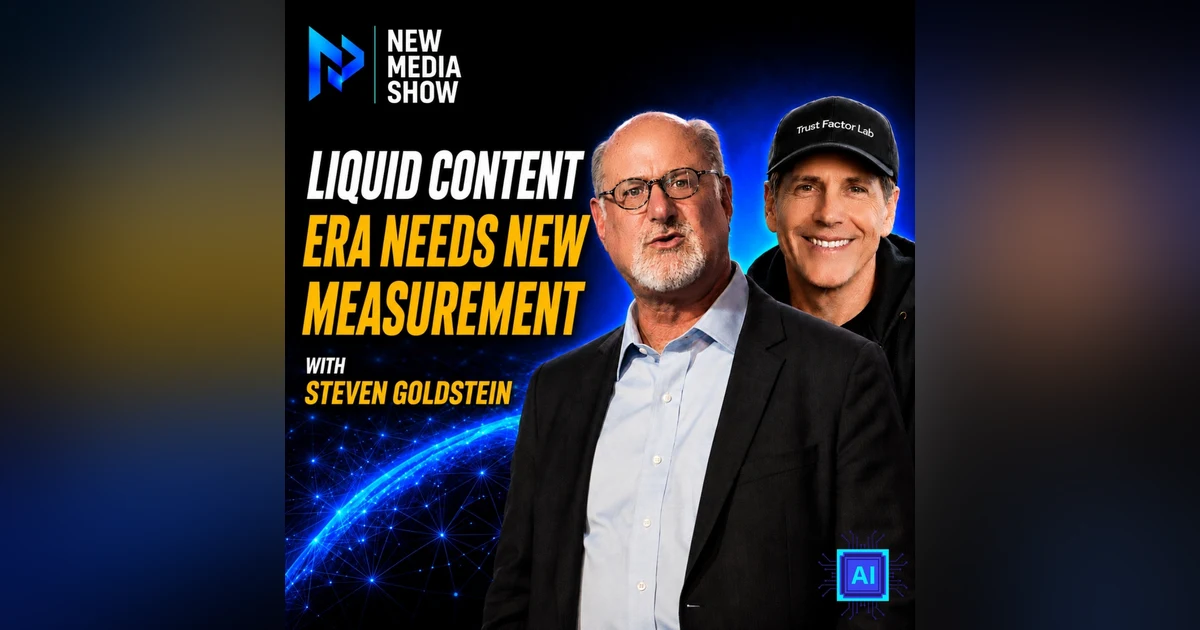


 In Episode 680 of the New Media Show, host Rob Greenlee welcomes Steven Goldstein, founder and CEO of Amplifi Media, for a timely, future-leaning discussion.
We have entered the Liquid Content Era.
A podcast conversation can now become an audio episode, full-length YouTube video, Spotify video, Apple Podcasts video, vertical clips, social posts, articles, newsletters, searchable transcripts, and potentially AI-discovered answers. The underlying content may be the same, but the way people encounter and consume it varies by platform.
That creates an enormous opportunity for creators. It also creates a measurement problem.
Podcasting built much of its advertising business around the download. That metric helped turn an emerging medium into a legitimate advertising marketplace, but Steven argues that it no longer adequately represents how audiences consume modern shows.
Downloads were created in an era when bandwidth was limited and podcast applications often downloaded episodes to devices before the listener played them. Today, streaming is increasingly immediate, video consumption is growing, audiences move between devices, and clips can sometimes reach more people than the original episode.
The question is no longer simply: How many times was the podcast downloaded?
The better question may be: How many people actually listened to, watched, encountered the advertising, and engaged with the creator’s content across the entire media ecosystem?
Why advertisers need this change.
Large brands already buy television, web, streaming video, social, and other digital media through dashboards that provide comparable impression-based reporting. Podcasting remains fragmented across RSS analytics, platform dashboards, YouTube views, Spotify data, and different definitions of what constitutes meaningful exposure.
That fragmentation makes podcast media harder to buy at scale.
Steven explains that advertisers do not want separate teams manually reconciling podcast audio, video, clips, and platform metrics.
If podcasting wants to attract substantially more advertising investment, it needs to fit more easily into the systems marketers already use.
That leads into one of the episode’s central topics: the AMP Accords.
The Alliance for Measurement in Podcasting was formed to address three persistent problems:
- Defining a podcast
- Standardizing exposure metrics across platforms
- Creating a more consistent way to evaluate advertising effectiveness.
The AMP Accords describe their goal as establishing cross-platform measurement standards spanning open RSS and closed platforms.
One of the biggest proposed shifts is moving toward a 30-second play as a standardized exposure metric across audio and video.
Steven is less concerned about whether 30 seconds ultimately proves to be the perfect number than he is about establishing a common starting point.
Media measurement has always evolved.
Steven draws on his experience in radio, where audience measurement moved from handwritten listening diaries to electronic Portable People Meters. The change was disruptive. Some formats gained audience under the new methodology, and others lost it. But advertisers demanded better information, and the industry eventually adapted.
Podcasting is facing a similar moment.
The industry should not allow the pursuit of a perfect measurement system to delay the adoption of a more useful one.
The AMP framework also addresses advertising impressions and audience measurement. That matters because an advertiser ultimately wants to know whether someone actually received an advertising message, not simply whether a media file was automatically delivered to a device.
Rob and Steven discuss the tension this creates for established podcast measurement.
Some publishers remain strongly committed to the download because it has provided consistency and an open measurement methodology for many years. Steven gives the download credit for helping build the podcast advertising business but believes the medium now needs to move forward.
The shift becomes even more important when video enters the equation.
YouTube has become a major podcast-consumption platform with sophisticated analytics on views, watch time, audience behavior, retention, and discovery.
Spotify has added video.
Apple is expanding its video capabilities through HLS. Meanwhile, audiences increasingly move fluidly between audio and video rather than seeing them as completely separate media products.
This raises another difficult question:
What exactly is a podcast now?
The AMP Accords propose a broad podcast definition that encompasses audio or video and open or closed distribution, provided the program remains meaningful without requiring constant visual attention.
Steven likes the basic framework but emphasizes that audiences will ultimately shape the word’s meaning.
People already call shows “podcasts” based on format and experience rather than on technical infrastructure. Most listeners do not know whether a show uses RSS feeds, direct platform uploads, streaming video, or another delivery method.
Rob raises a concern about defining podcasting too strongly through an audio lens.
If a video must always function perfectly with the viewer’s eyes closed, does that discourage creators from investing in richer visual storytelling?
That question becomes increasingly important as video production matures.
A modern video podcast can include visual demonstrations, graphics, archival material, set design, screen sharing, camera movement, and other elements that provide additional value to the viewer. Rob argues that creators should retain the freedom to build excellent audio and excellent video experiences, even when the two versions are not identical.
The discussion then moves to another major part of liquid content: short-form video.
Shorts or Clips were initially treated primarily as promotional tools designed to push people toward the full episode. That assumption is changing.
Some audience members may never consume the full show. They may know a creator entirely through Shorts, Reels, TikTok, or other excerpts.
Steven describes this as both an opportunity and a potential problem.
If a creator publishes the four best moments from an hour-long conversation, some viewers may decide those clips provide everything they wanted from the episode.
That means short-form may represent a separate audience, not simply a funnel into long-form media.
At the same time, social clips have become an increasingly important discovery mechanism.
Creators cannot simply ignore the places where audiences spend their time.
That is the essence of liquid content: the audience determines where and how the media gets consumed.
Artificial intelligence adds another layer.
Steven believes creators should increasingly think beyond traditional SEO, Search Engine Optimization, toward AEO, Answer Engine Optimization.
AI systems are increasingly becoming discovery engines themselves. Instead of searching through a list of websites or podcast episodes, a user may ask an AI system a specific question and receive a direct answer assembled from available sources.
That shift could be especially valuable for niche creators.
A podcast with deep authority in a narrow subject may become an important source of AI-generated answers if its content is well-structured, transcribed, accessible, and clearly associated with expertise in that category.
Rob expands the discussion into recommendation systems.
YouTube already uses AI extensively to determine which content should be presented to which audience. Similar systems will increasingly influence discovery throughout digital media.
That creates a harder competitive environment.
Steven argues that mediocre content will be crushed. As audiences face effectively unlimited choices and algorithms become better at filtering those choices, simply producing acceptable content may no longer be enough. Shows need differentiation, relevance, expertise, strong personalities, or storytelling that holds attention.
That does not mean every successful podcast needs millions of listeners.
Steven points to niche podcasts serving highly specific professional communities. A show about HVAC systems may never become a mainstream entertainment hit, but it can still become an extremely valuable business if it reaches the right technicians, manufacturers, buyers, and industry decision-makers.
Influence within a valuable niche can matter more than raw audience scale.
The conversation closes by examining the tension between short-form and long-form media.
Consumers are time-starved.
Summaries, clips, AI-generated takeaways, and compressed content are becoming increasingly useful.
Yet long-form is not disappearing.
Joe Rogan, Acquired, Dan Carlin, and other successful long-form creators demonstrate that audiences will still spend hours with content when the storytelling, expertise, personality, or subject deserves the investment.
The real challenge is earning the audience’s time.
In the Liquid Content Era, creators are no longer simply publishing episodes. They are building adaptable media assets that can move across platforms, formats, screens, algorithms, and audiences.
The measurement systems now need to catch up.
Topics Covered in This Episode:
-What Steven Goldstein means by the Liquid Content Era
-Why one piece of content now becomes many media products
-Why the podcast download is becoming less representative of consumption
-What podcasting can learn from radio and television measurement
-Why advertisers need unified cross-platform metrics
-The AMP Accords and the future of podcast measurement
-The proposed 30-second play standard
-Plays, audience, ad impressions, and ad audience
-Audio versus video measurement
-Apple HLS, YouTube, Spotify, and platform competition
-Why the definition of a podcast continues to evolve
-Whether video podcasts need to work with the viewer’s eyes closed
-The difference between clipping content and creating for vertical video
-Why clips may represent a separate audience
-AI and Answer Engine Optimization
-How algorithms increasingly control media discovery
-Why mediocre content faces greater pressure
-High-value niche content versus mass audience scale
-What it takes to create a hit today
-Why long-form content can still win
Chapter Time Stamp Markers
00:00 Welcome to The New Media Show Episode 680
00:36 The Liquid Content Era needs new measurement
01:10 Introducing Steven Goldstein of Amplifi Media
02:07 Why media has entered the Liquid Content Era
03:18 The New York Times as a liquid content example
04:41 Podcasting moves from audio into multimedia
05:29 Video was always part of podcasting
06:22 Why the download originally made sense
07:13 Streaming changes how podcast consumption is measured
08:08 What podcasting can learn from radio measurement
09:11 From listening diaries to electronic measurement
10:00 Why advertisers need podcasting inside their dashboards
11:05 Audio and video buying remain separated at agencies
12:06 How television moved toward impression-based measurement
13:13 Short-form video enters the podcast media mix
14:12 Introducing the AMP Accords
15:08 What the AMP Accords propose
17:03 What AMP got right and what could go wrong
18:41 Why 30 seconds is a starting point, not the final answer
20:06 Moving beyond the download
21:23 Downloads do not always equal actual listening
22:03 The IAB and industry resistance to changing measurement
23:20 Some shows will gain, and others will lose under better metrics
24:18 Why Steven believes the download cannot be the future
25:11 Consumer behavior is forcing podcasting to change
26:02 Vertical video becomes a major media business
27:01 Can YouTube, Spotify, and Apple align around new metrics?
29:16 Comparing 30-second and 60-second exposure
31:07 Plays, audience, ad impressions, and advertiser needs
32:16 Why advertisers dislike hidden podcast audience numbers
33:07 Measurement matters differently for niche podcasts
34:19 How audiences move between audio and video
36:05 Should audio and video come from the same media file?
37:02 Why measurement does not need to be perfect to improve
38:16 Liquid content keeps expanding into new formats
39:14 What qualifies as a podcast now?
40:02 The audience may ultimately define podcasting
41:35 Does “eyes closed” unfairly prioritize audio?
43:05 Could the new definition weaken video creativity?
44:31 Separate audio and video podcast experiences
46:07 Vertical video versus automatically generated clips
46:52 Are clips replacing the full episode?
48:04 Short-form audiences may be entirely different
49:00 AI enters the Liquid Content Era
49:28 SEO shifts toward Answer Engine Optimization
50:27 AI becomes the first layer of media discovery
51:13 Algorithms judge what audiences see
53:04 Why mediocre content will be crushed
54:02 What qualifies as quality content?
55:04 Niche media does not need mass scale
57:07 How specialized podcasts can build valuable businesses
58:38 Why podcast creation remains flat despite creator growth
1:00:16 Creators no longer need traditional media gatekeepers
1:01:21 What the COVID podcast boom taught the industry
1:02:27 High-value content and why hits are hard
1:03:05 Differentiation as the foundation of a successful show
1:05:05 What television can teach podcasters about format innovation
1:06:22 Why creators compete for increasingly limited audience time
1:07:34 Short-form versus long-form content
1:08:22 Why people increasingly use AI to summarize long content
1:09:08 Joe Rogan, Acquired, and why long-form still succeeds
1:10:05 Gen Z will consume long content when it earns the time
1:11:01 Structured YouTube content versus podcast conversations
1:13:00 Final thoughts on the changing New Media landscape
1:14:00 Where to find The New Media Show
Guest: Steven Goldstein, Founder and CEO, Amplifi Media
Amplifi Media: https://www.amplifimedia.com
About Steven Goldstein: https://www.amplifimedia.com/about
Steven Goldstein on LinkedIn: https://www.linkedin.com/in/steven-goldstein-a057b54
Amplifi Media on LinkedIn: https://www.linkedin.com/company/amplifi-media
Steven Goldstein is founder and CEO of Amplifi Media and teaches The Business of Podcasting at NYU. His current work focuses heavily on the shift toward cross-platform audio, video, and social distribution, as well as what he describes as the Liquid Content Era.
AMP Accords
Alliance for Measurement in Podcasting: https://ampaccords.com
The AMP Accords focus on three areas: standardizing impression metrics, developing cross-platform performance measurement, and creating a common industry definition of a podcast.
Host, Rob Greenlee, and New Media Show Links
New Media Show: https://newmediashow.com
New Media Show on YouTube: https://youtube.com/@TheNewMediaShow
New Media Show Audio on Apple Podcasts: https://podcasts.apple.com/us/podcast/new-media-show-audio/id392545649
Rob Greenlee Website: https://robgreenlee.com
Rob Greenlee on LinkedIn: https://www.linkedin.com/in/robgreenlee
Rob Greenlee on YouTube: https://youtube.com/@RobGreenlee
Podcast Hall of Fame: https://podcasthall.com
AI Disclosure Note:
AI tools were used to create a video and audio introduction clip, episode images, help organize and edit this episode and summarize its description, and create chapter markers from the completed Episode 680 transcript. The recorded conversation, human performances, guest perspectives, editorial direction, final review, and responsibility for the published content remain with actual humans Rob Greenlee and Steven Goldstein.
The post Liquid Content Era Needs New Measurement | Steven Goldstein, Amplifi Media #680 first appeared on New Media Show.