30 Years and Counting - Lessons Taught and Lessons Learned | Dr Steven Greene - Ep 176
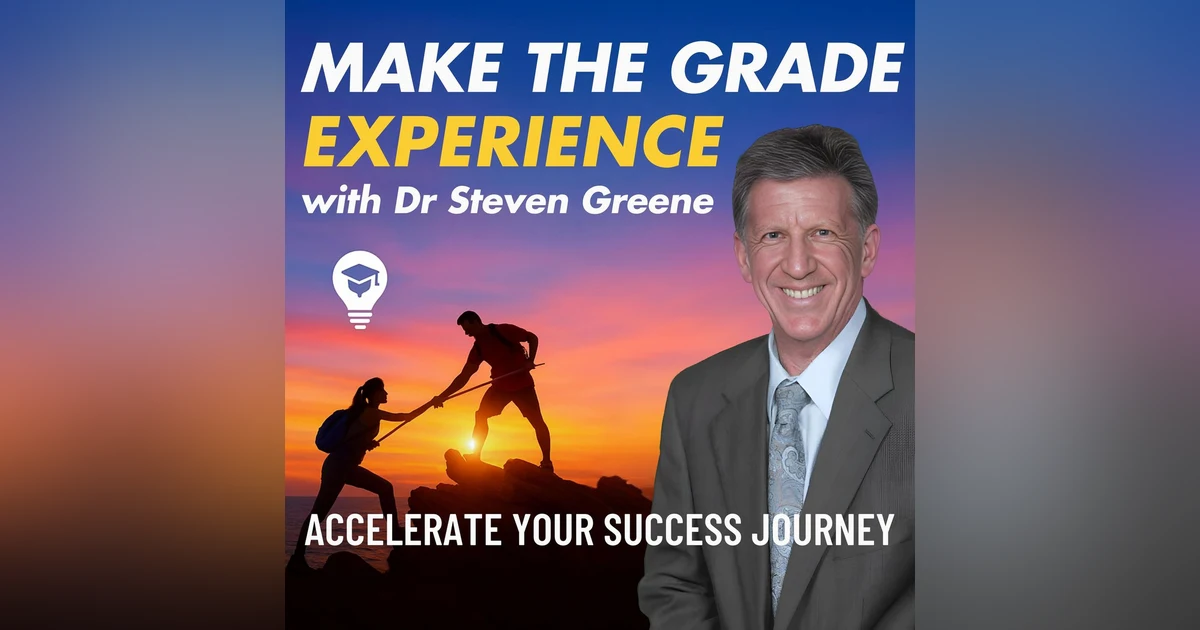


On September 1, 1995, Dr. Steven Greene opened the doors to what would become Make the Grade, a tutoring and educational services company dedicated to empowering students and families.
Thirty years later, Dr. Greene — founder, owner, lead educator, and host of The Make the Grade Experience Podcast — takes a moment to look back on this incredible journey. In this reflective episode, Dr. Greene shares the lessons he has learned not only from teaching thousands of students but also from building and sustaining a successful educational business. From the intangibles of mentorship and trust, to the practical realities of running a company, Dr. Greene discusses the people, the stories, and the values that shaped Make the Grade into the multifaceted platform it is today.
Key Takeaways
✨ The origins of Make the Grade Academic Services in 1995
✨ How education, mentoring, and community have defined the mission
✨ Lessons learned from both successes and challenges along the way
✨ Gratitude for the countless students, families, and colleagues who made this 30-year milestone possible
✨ Why education is not just about academics, but about transformation
About the Host
Dr. Steven Greene — Educator, entrepreneur, and mentor. Founder and lead educator of Make the Grade, creator of the Student Entrepreneur Academy, and known as The Success Doctor, Dr. Greene has spent three decades helping students succeed academically and personally. His mission is simple: to empower individuals with the knowledge, skills, and support they need to reach their highest potential. Call to Action 💬 Share your own “lessons learned” from education, business, or life — Dr. Greene would love to hear from you!
🔔 Subscribe to The Make the Grade Experience Podcast for insights on education, success, and entrepreneurship.
Learn More...
Submit your request here:
I want to be on the mAke the grAde Experience Podcast
Check out all that Dr Greene offers:
http//:www.makethegrade.net
Entrepreneurial Opportunities:
I want to be an entrepreneur
The Student Entrepreneur Academy
The Student Entrepreneur Academy
Reach Dr Steve directly:
sgreene@makethegrade.net
0:03 Hey, welcome everyone to Make Great Experience podcast. You have a little bit of the different show today. Why today is September one, twenty twenty five. On September the first, nineteen ninety five, thirty years ago today, maybe nobody noticed, but that was the opening day of what was then called Make the Grade Academic Services, which became the Made to Grade tutoring concern and moves on to this day in its present incarnations. So I want to take a short amount of time and reflect on this journey, on this process, what it's taught me in addition to what I've been able to teach others. I could do this sort of statistically, I guess and say, well, I've worked with so many students and so many success stories and so much of this, But I'd rather take a position of from the intangibles. So first of all, I have to thank all of the people, and they're way, way, way, way, way, way way too many to name who encouraged this, gave me insight, shared professional advice, not just in the teaching side, but in the business running a business, the entrepreneurial piece
1:36 of it. My family, my wife of course, for supporting this as opposed to get a real job, but she never said and making this work. And the short version of the beginning of this was I was teaching. I had a teaching job, and another teacher came to me and said, there are some students who are needing tutoring help. Would you be willing to do it? And I said, sure, it's something I can do. The subject I understand at the time it was chemistry and math, which is still staples in the Mad Degrade. I guess offerings, and I realized very very quickly, working with these students one on one a different experience than teaching in front of a classroom of whatever fifteen thirty people. It's a lot more immediate.
2:36 You work on something and there's an immediate we're not a sense of improvement or sense of discovery. And I found that very gratifying. And it would be disingenuous to say that every single time I worked with a student there was an epiphany that that's just not how it works. But there were so many wins and so many little things that added up to medium sized things that add up to bigger things, and over time, by two years later, by nineteen ninety seven, this became a full time venture I got out of the classroom and my thought was, well, I'll do this for a while and see how if I can make both things where I'm and I'll go back to teaching. In the middle of that, I had a first child. My wife and I had a child, and it just never went that direction. And ultimately, thirty years later, still in the driver's seat, make the grade alive and well, it has morphed and it bridged into several other places, which I'll talk about a little bit, but essentially, I think this is what I've learned is number one, you must meet your clients where they are.
4:00 You must provide what they need. If I felt this is the way it's going to happen, and this is the only way it's going to happen, and this is how I do things, and too bad for the students or whatever, this would not even have come close to being a success, certainly not at the scale it has been. And I realized that very quickly, and I knew that anyway from teaching. When you're teaching a heterogenous classroom, you have to learn different ways to reach different students simultaneously. It's a very interesting challenge, and with tutoring it was the same thing I had the days I worked with seven, eight, ten students individually, back to back to back to back to back. I could have had ten different teaching styles, ten different methodologies, and you had to learn to be able to do that. You had to be able to learn to adapt. But in the end, nobody is going to be successful in or touring business unless you have success with your students, unless you have an ability to get them to become independent. Because even in a perfect situation, you can't go in and take a test for them.
5:10 You can't sit there and work on the sat with them live or the act or any of the many, many things that we've worked on students with. It's all about building up skill set. So for the late nineties most of the two thousands I kind of hustled. I mean I was an entrepreneur. I had to get business. And one of the things about tutoring if you're looking to go into tutoring, and that's a great business if you can sustain it, is that your students tend to have a very short lifespan. Sometimes I work with students for two weeks, they'd have trouble with the subject, we would improve it and they would move on. Sometimes I'd be with them a few years. Every once in a while, I had a few families that have had lots of children and i'd work. I was with some of them twelve fifteen years time, but I had to hustle. Now. Note, just to put a good context here, this was before cell phones. This was really before the internet. The first place I promoted was in newsletters PTO newsletters and newsletters at churches and synagogues in my local area. And this was way before anything you've resembled online instruction. I would drive and work with students in their house, and I know there's still tutors that do that, and there's tutors that meet peopleilt libraries. In nineteen ninety eight, I set up an office and basically I said, look, this is
6:43 where I tutor. If you would like to tutor, you need to come to me in this office, with some rare exceptions, And by about two thousand I was one hundred percent at the office, and fortunately I had an ongoing parade of students in read after the other three o'clock four five o'clock weekend's nine, ten, eleven, twelve, one, two through four five whatever and hustle. You gotta hustle. It's a business like anything else. You got to let people know you have a service, you have to market, you got to deliver. And what started to happen when social media started to become a thing all of a sudden day, you can advertise on this Facebook, you can advertise on these online situations. But ultimately, it was never really about that for me, and I'm still not even at this point, really very good at all on social media.
7:37 It was more about taking care of my clientel, the families, the students, and having them spread the word for me, because let's be honest, and I was the same way. I'm a parent of two children. When your child has success, you'd like to talk about it. Guess what, little Melissa, she got a hundred on her math quiz. She was struggling before. That's great, Well how'd you do it? How'd she do it? Oh? Well, we picked up this tutor and he did this and that, and she loves working with him and we're getting results and yeah, yeah, yeah, yeah yeah. And that's how it grew. It grew organically like that. And again I want to thank every parent, every student, every teacher, who ever referred a family to me.
8:23 I think I did at the time as well, but I think globally that appreciation needs to be expressed because that's what really made the business. So most of the two thousands, I'm hustling and I'm building things up, and I'm working, and I'm doing this, and I'm doing that, and I got little kids, and when I'm not tutoring, I've got themn to karate classes and sports and things like this. And what really was a big, a big watershed for the business was in twenty fourteen wrote my first book called The Maximum Education. Happened to have a copy year. If you're listening, you won't see it. Of course, it's only eighty two pages, and only eighty two. Something like twenty are diagrams, not like doodle pictures, but like pictures of how to make outlines. This book is about maximizing your education. Subtitled The Ultimate Guide to Optimal Academics.
9:23 Everyone has a beautiful picture on the back and a little bio, and the book was about how to study. It addressed things I was doing with students that were not academic, how to take notes, how to outline, how to prepare for tests, how to prepare for big high stakes tests like midterms, finals and SATs, hands on things. And I'm not saying they weren't addressed in schools, and I'm sure some teachers, some classroom teachers did, but they weren't primary topics. And this little book I I sold over forty thousand of them over time, gave away probably five thousand speaking or to my students or in schools, go into PTOs and do a talk and give away books, or do assemblies and give away books, or do workshops and new books be included in the workshop. But it also opened up a whole other channel. It opened up a channel to now not just be a math tutor or chemistry or a physics or biology tutor, or an SAT or ACT tutor, which I became known for or am known for, but also what they now call executive function teaching skills that apply across the board to all these things. Structure, time structure, time management, information catalog and information management, very important things. But guess what they don't
10:55 or didn't just apply to education, They also applied to entrepreneurship. They also applied to business. So in twenty seventeen this was another big watershed thing. I was invited to speak at a very large Chamber of Commerce workshop. It was kind of like a three quarter day event centered on entrepreneurship. Okay, and this was before like the Day's a Shark Tank one. Entrepreneurship was sort of cool in a sense, like it was like a goal of everybody. Back then, it was like it you just basically had a job for yourself. You were a hustling. So I'm going to speak. I'm on a panel and also did a short keynote address at this event. And there was like three hundred people there from all over the region talking about entrepreneurship and how to and why and what's this and what's that, what to avoid and what to do. And I wrote a little an article I guess you would call it an article blog called the Day in the Life of an Entrepreneur. I published it in my blog. I'm not even sure the blog existing. I'm sure it's somewhere Artifa actually, because in twenty eighteen I transitioned into podcasting, which is sort of an audio blog in that sense. Any Hey, anyhow, so I wrote this blog post and I referred to it during this event over and over and over. Go look at this and I printed it out and I gave it out and what happened was very surprising to
12:28 me because I used my role in tutoring and education as an example of all things that have happened in my entrepreneurial journey. I said, you can apply these same principles regardless of what you're doing, selling insurance or running a jewelry store, being a personal trainer, or I'm just trying to think of things yoga instructor car sales, anything, they're all they're universal. So at the end of the workshop, there's a I'm a Q and A and then we broke up and they're having like a little reception and food and drinks and things. And I had about twenty people come up to me and say it was great.
13:08 We'd love to take your workshop, your workshop, my workshop. Guess what, people, I didn't have a workshop. I'm getting in But I said, I'll tell you what. Let me have your business card. That's how long ago was in those little things like a couple of inches long inch or too high, had your phone number and stuff on. At what you did. I got thirty seven business cards, plus I had the director of all the people that were registered for the event and I emailed them. Yet we did have an email, and I said, look, for those of you who asked about it, I am running a workshop the Day in Life of not your workshop. If you would like to register, call me like on a phone. I had the dial or reply to this email.
13:54 I registered twenty six people and spawned an entire division of the Make the Great Company now educating, supporting, mentoring entrepreneurs, which is now kind of its own division called the Triangle of Success. So you'll hear me refer to the Triangle of Success occasionally or often within the podcast. It's a kind of wholly owned, I guess division of Make It Grade. It just focuses on the entrepreneur side as opposed to the academic side, and the triangle was based on the premise, but there were things entrepreneurs needed to master in order to be access successful. Still is seven eight years later, it is thriving. In fact, the entrepreneurial side has overtaken the academic side. About three years ago, COVID did adjust the playing field a lot. Remember that twenty to twenty two twenty three, where the entrepreneurial side, the Triangle of Success side is is much more growing much more quickly and is a lot more business in it than the tutoring side. Interesting, of course, the entrepreneurs a lot more entrepreneurs, So there are people taking math.
15:18 It doesn't matter. The point is they're both being served and they're both basically getting the same foundational things. What it takes to be successful, What it takes to have a structure, what it takes to have the mindset, what it takes to have the self discipline, where it takes to have the actual technical So an entrepreneurship, the technical might be one thing in algebra, it's the rules of algebra, and chemistry's as chemistry and SATs it's the SAT success plan. I make the great SAT and Act success plan. It works to work for a hundred, maybe thousands of students, maybe ten thousand students. Yeah, so let's kind of flash to the present, thirty years in. Where's this going to go?
16:03 Right now, there are basically three things on my plate. Number one remains the tutoring. That is the kind of steadfast common ground since nineteen ninety five, the triangle of success working with entrepreneurs. They enjoy that equally different challenges, different daily things to do with deal with but just as enjoyable from my perspective. And in the last few years there's been an opportunity which is also expanding very quickly, to work with big businesses, corporate and I have become, i don't want to say by accident, but not by any specific plan, a big expert in the training field within the new digital economy, things like cryptocurrency, decentralized finance, decentralized banking, real world asset tokenization. And I have companies that I have helped create training manuals and educational situations and circumstances. And I have a company right now that's offered me a role of creating a training academy for them and managing that. It's really very exciting. It's cutting edge, and I think it's where things are going. I'm not an charatomist, obviously, I'm not a world leader that way,
17:37 but I know a lot about it and I've had to learn a lot about it to be involved in these roles, and it's changing quickly. So let me wrap this up by saying this, I'm going to kind of end where it began. A giant thank you to everyone. Again, I couldn't even start to name them because I could go back to the nineties, who helped me launched this concept, supported this concept, believed in what I was doing, believed in me as a provider, all the families, all the students, so many success stories, so many challenges that we had to overcome, and it would be naive to think every single student had an incredibly great experience. I'm sure some probably could have done a better job, but it's just the idea of giving the effort and making sure you're there for them, and making sure you're showing up and working late at night and getting up early in the morning to do it. And this is where all the parallels with the entrepreneurism really came through. So that transition to that expansion was very, very natural, and I think it will continue to be. So a giant thank you.
18:48 Thank you to people I haven't even got to work with yet, who I will soon, because that's the direction things are going. I thank the people that helped me to embrace technology, like recording this podcast, getting it out there and feeling more comfortable with the tech and incorporating the tech and integrating it in with the education. I've been lucky to create a lot of courses on video and continue to and I think that's ultimately where some of this legacy would be. I'll close out by saying, there's another project, the Student Entrepreneur Academy Student Entrepreneur Academy, which I began in twenty twenty right in the middle of COVID, right in the middle of COVID, where exactly what the name is I want to pass along along with bringing in all these people I know, the things I've learned, the experience to the next generation. The immodest tagline of the academy is the Student Entrepreneur Academy is providing and providing education and information empowering the next ten thousand entrepreneurs. This is a legacy project, partnering some network and companies to do this, partner with a lot of people that can mentor that can help with a faculty.
20:07 So this is the evolution of where things are gone thirty years. Maybe in ten years I'll be doing the forty year anniversary September one, two thousand and thirty five. I believe it. That sounds kind of crazy, but that's where it goes. Yeah, So again I'm going to close out by saying thank you. Any feedback would be great. Please share this if you found it valuable. I know it's about me, but I really think it's about the journey, and I think it's a journey people could learn from. Never give up, never quit, never question ultimately what you want to do, question the details, don't question the macro, stay on course. Partner with really strong people will help you get out of the way of people that want Then we go from there. So thanks again everyone, Thanks again, and let's take it to the next step. I'd love to work continue to work with people in any one of these projects, the tutoring project, the entrepreneur project, the student entrepreneur Academy project, the decentralized finance projects. These are all things that involve partnerships. So doctor Stephen Green to make the Great Experience Podcast a little bit different today, but I hope you enjoyed it. I hope you got something out of this. It's all about taking action, right, So what did you learn from today? Get a plan, work the plan, stick with the plant, modified as you have to, but don't give up. I'll see you on the next episode. Thank you so much. Talk to you
21:41 next time.